
The Four-Layer Framework for HR AI: Why Your Stack Is Probably Broken
There is a pattern playing out inside almost every large organization right now. An HR team deploys an AI tool, runs a successful pilot, generates positive internal press, and then watches adoption quietly plateau. The tool gets used by enthusiasts, ignored by the mainstream, and eventually categorized as “we have AI” without meaningfully changing how work gets done. Leadership moves on to the next announcement.
- The Four-Layer Framework for HR AI: Why Your Stack Is Probably Broken
- The Argument in Brief
- Why Layer 1 Obsession Is So Predictable
- The Integration Layer Is Where the Real Differentiation Happens
- Decision Intelligence Is the Destination, But Almost Nobody Is There
- The Five Questions Every HR Technology Decision Should Start With
- The Competitive Implication CHROs Should Not Miss
- Bottom Line
This is not a technology failure. It is an architecture failure. And a framework published by Nasscom’s community makes a genuinely useful attempt to diagnose exactly why it keeps happening.
The Argument in Brief
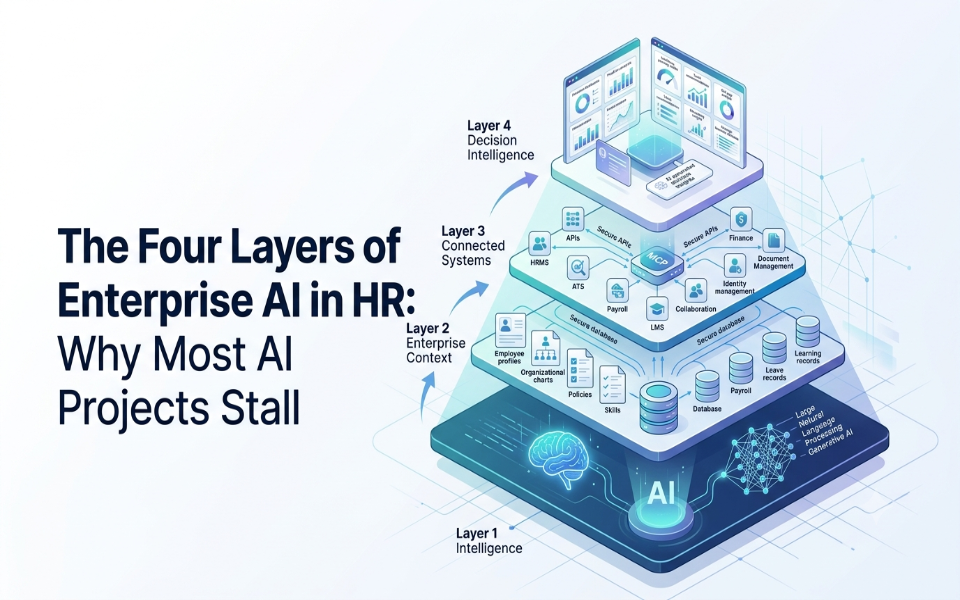
The piece posits that enterprise AI in HR operates across four interconnected layers: the AI model itself (Intelligence), organizational data that makes responses relevant (Enterprise Context), the connected systems that allow AI to act across the full HR stack (Connected Systems), and the proactive pattern-recognition capability that elevates AI from assistant to strategic advisor (Decision Intelligence). The core thesis is that most organizations invest almost exclusively in Layer 1 while treating Layers 2 through 4 as someone else’s problem — typically IT’s — and then wonder why business value fails to materialize.
That diagnosis is correct. And it has significant implications for every executive with budget authority over HR technology.
Why Layer 1 Obsession Is So Predictable
The gravitational pull toward the model layer is not irrational. Large language models are genuinely impressive in demonstration. They write, summarize, translate, and answer questions with a fluency that creates an immediate sense of capability. Vendors know this, which is why enterprise AI sales cycles are still heavily demo-driven. You show the CHRO a beautifully articulate AI assistant answering an employee question, and the budget conversation begins.
What the demo almost never shows is the AI attempting to answer a question that requires knowing how many PTO days a specific employee in the Singapore office has remaining under the Q3 policy revision, routed through a manager whose approval chain was reorganized six weeks ago. That is the real enterprise use case. That is where the seams show.
The Nasscom framework names this gap cleanly: a capable model without enterprise context produces answers that are accurate in the abstract and useless in practice. The contrast it draws — between “What is annual leave?” and “You have nine annual leave days remaining, and your manager is the approving authority” — is deliberately simple, but it captures something real. The distance between those two responses is not a model quality problem. It is a data architecture problem.
The Integration Layer Is Where the Real Differentiation Happens
Layer 3, Connected Systems, is where the framework gets most interesting and where the competitive dynamics become genuinely consequential. HR does not run on one platform. It rarely runs on five. Most enterprise HR environments are a historical accumulation of best-of-breed point solutions — an ATS here, an LMS there, a payroll system with a 2011 integration contract, a collaboration platform added during the pandemic, an identity management layer that predates cloud — stitched together with a combination of APIs, middleware, and human workarounds.
The framework correctly identifies the Model Context Protocol (MCP) as an emerging standard worth watching. MCP matters because it attempts to give AI systems a standardized way to query and interact with disparate enterprise tools without requiring bespoke integration work for every connection. If it achieves meaningful adoption — and the early momentum from Anthropic, followed by rapid support across the vendor ecosystem, suggests it might — it changes the integration calculus significantly. Organizations that have invested in clean, well-governed data and API-accessible systems will be able to plug into this emerging interoperability layer quickly. Organizations running on legacy, siloed infrastructure will face the same integration debt they have always faced, now with the added pressure of falling behind on AI capability maturity.
This is the crux of why some organizations will scale AI faster than others. It is not access to the best model. Every major enterprise AI vendor is either building on or accessing the same frontier model infrastructure. The differentiator is how much of the organizational context that model can reliably access, and how many systems it can take action across. That is an integration and data governance problem, not a model selection problem.
Decision Intelligence Is the Destination, But Almost Nobody Is There
Layer 4, what the framework calls Decision Intelligence, is where the value proposition becomes genuinely transformational rather than incrementally productivity-improving. The examples offered — identifying emerging skill shortages, flagging departments with rising workload pressure, recommending internal candidates, detecting onboarding bottlenecks, forecasting workforce requirements against business demand — describe a fundamentally different role for AI in the organization. Not answering questions that humans ask, but surfacing patterns that humans would not have known to look for.
This is the agentic AI layer that Deloitte’s 2025 HR Technology Marketplace Trends research identifies as the next major evolution, and it is the layer where most organizations are genuinely nascent. The reason is straightforward: you cannot get to Decision Intelligence without first having the data quality, system connectivity, and organizational trust that Layers 2 and 3 require. Decision Intelligence is the compound interest on foundational investment. Organizations that skipped those foundations are not just behind — they are starting from a different baseline entirely.
The McKinsey finding cited in the piece reinforces this: organizations achieving the highest AI returns are integrating it into core business workflows, not deploying it as an isolated productivity tool. That is not a subtle distinction. A workflow-integrated AI system that proactively surfaces a retention risk before an employee starts interviewing externally is categorically different from an AI chatbot that helps HR write a job description faster. Both are “AI in HR.” Only one is transforming the business.
The Five Questions Every HR Technology Decision Should Start With
The framework’s closing diagnostic questions deserve more attention than they typically receive in vendor evaluation processes. Is our workforce data accurate and well governed? Can our enterprise systems securely share information? Do managers trust the insights generated by AI? Are employees comfortable interacting with AI for workplace tasks? Does our technology architecture support future interoperability? These are not preliminary checklist items to clear before the real AI conversation starts. They are the real AI conversation.
The data governance question is particularly underweighted in most enterprise AI discussions. AI systems are probabilistic amplifiers — they amplify whatever signal exists in the underlying data. If your workforce data is inconsistent, politically shaped, or simply outdated, AI-driven decision support will produce recommendations that are confidently wrong in ways that are harder to detect than the obviously wrong outputs of a poorly configured rule engine. The organizational risk is not hypothetical. Hiring decisions, compensation recommendations, and talent mobility suggestions informed by AI drawing on biased or inaccurate data create legal exposure, cultural damage, and erosion of exactly the managerial trust that Layer 4 depends on.
The Competitive Implication CHROs Should Not Miss
Here is the position worth taking plainly: the organizations that will achieve durable advantage from AI in HR are not the ones that move fastest to deploy AI applications. They are the ones that treat the next eighteen months as a period of foundational investment — cleaning data, establishing governance, building system interoperability, and developing the organizational capability to act on AI-generated insights. The application layer will commoditize. The foundation will not.
This is an uncomfortable message for organizations whose AI strategy is currently “we signed an enterprise agreement with a major AI vendor.” That is a Layer 1 bet. It may produce real near-term productivity gains, particularly in content generation and routine query handling. But it does not create the structural advantage that comes from an organization where AI has reliable access to clean organizational data, can act across connected systems, and is trusted by managers to inform consequential decisions.
Microsoft’s framing of AI-first organizations — where connected AI agents work across multiple enterprise applications to support knowledge workers — points toward where the competitive gap will be most visible. The organizations that get there will not have arrived by purchasing the right AI tool. They will have arrived by building the right infrastructure, establishing the right governance, and cultivating the organizational habits that allow humans and AI systems to work together in ways that improve decisions rather than just accelerate tasks.
Bottom Line
The four-layer framework is a useful diagnostic for any HR leader trying to understand why AI investments are not translating into business impact. The insight that most organizations are over-indexed on Layer 1 and under-invested in Layers 2 through 4 is accurate, actionable, and explains the pilot-to-plateau pattern that has become the default trajectory for enterprise AI in HR. The organizations that recognize this early and redirect investment accordingly will compound their advantage over the next several years in ways that will be very difficult for late movers to close.
The future of work belongs to organizations that built the right foundations, not the ones that bought the most AI tools. That gap is opening now.
Based on reporting from The Four Layers of Enterprise AI in HR: Why Some Organizations Will Scale AI Faster Than Others | nasscom, originally published 2026-07-08 09:14:00.