
Share with your CTO
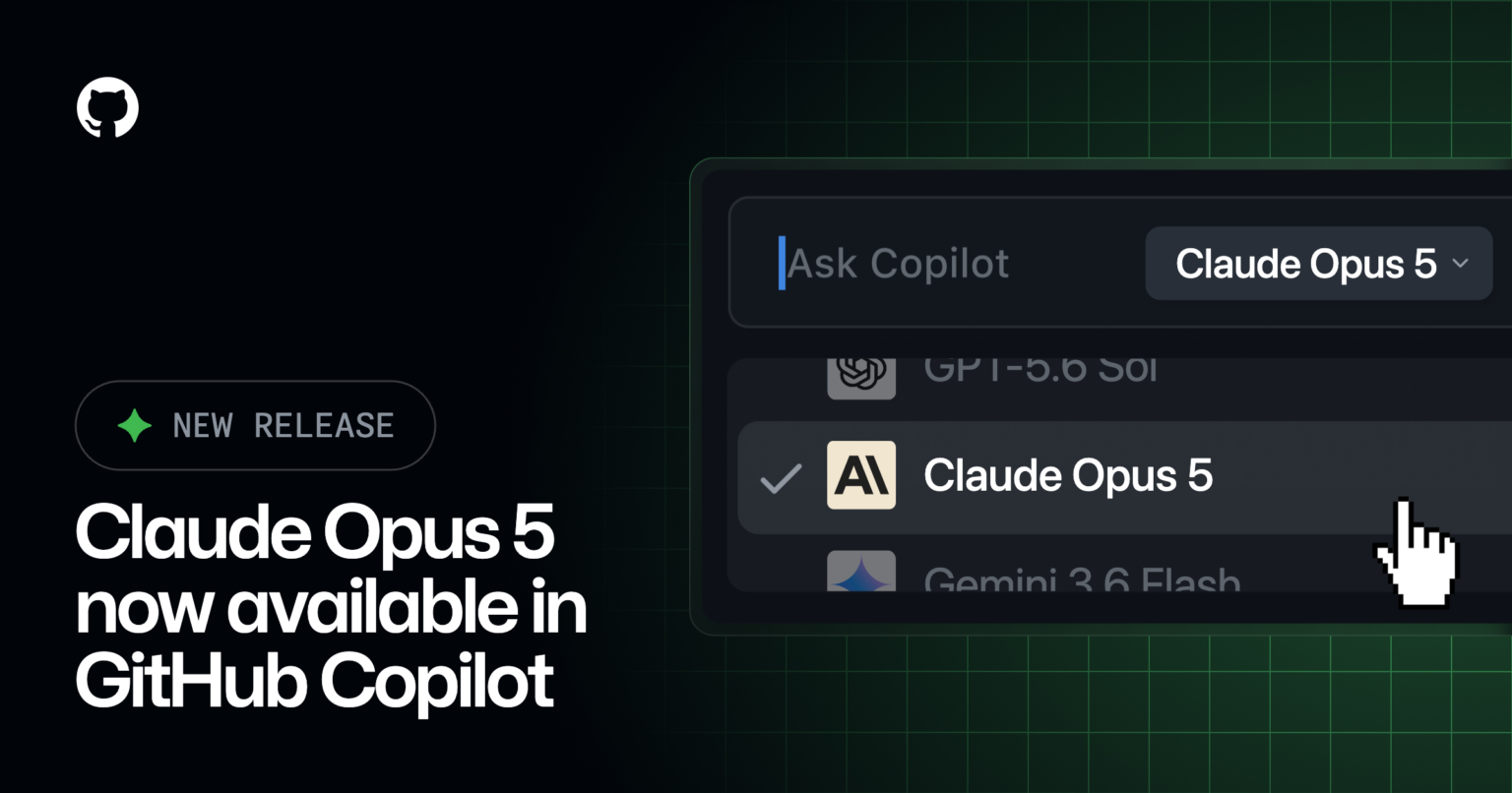
GitHub is pushing Claude Opus 5 into its Copilot platform across every major IDE and environment, from VS Code and JetBrains to Xcode, Eclipse, and the Copilot cloud agent. The model targets complex, multi-step agentic coding tasks: autonomous code changes, regression verification, and coordinated tool use across long-running workflows. It’s available to Copilot Pro+, Max, Business, and Enterprise tiers under usage-based billing at provider API list price. Enterprise and Business admins must explicitly enable it via policy settings before their developers can access it.
What this means for your business
The model picker in Copilot is quietly becoming the most consequential infrastructure decision in developer tooling. When your engineers can route complex refactoring tasks to Opus 5 and simpler completions to lighter models, the cost profile of AI-assisted development stops being a flat subscription line and starts behaving like cloud compute: shaped by usage, not headcount. That’s a fundamentally different procurement and governance problem than anything your engineering org has managed before.
The agentic framing here matters more than the benchmark numbers. Most coding AI tools have operated as autocomplete with better context windows. Opus 5’s emphasis on multi-step execution, regression verification, and tool coordination describes something closer to an autonomous junior engineer than a smarter tab-complete. The pattern this fits is the same one that played out when CI/CD pipelines first automated deployment: teams that integrated the tooling into their workflows saw compounding productivity gains, while teams that treated it as an optional convenience got left behind within two to three release cycles.
The security caveat buried in the announcement is worth flagging to your CISO before your developers hit it in production. Opus 5 includes enhanced filters for “high-harm cyber content,” which means security engineers working on penetration testing tools, vulnerability scanning, or red-team automation may encounter unexpected blocks mid-workflow. The signal worth watching: how often those filters trigger on legitimate internal security work, and whether Anthropic’s threshold calibration keeps pace with enterprise security use cases as the model matures.
Concept deep-dive: Agentic coding workflows
Agentic coding means an AI model doesn’t just suggest the next line of code. It executes a sequence of actions: reads a codebase, makes targeted edits, runs tests, interprets the results, and iterates, all without a human in the loop at each step. The analogy is the difference between a GPS giving you turn-by-turn directions and a self-driving car completing the route. For engineering teams, this shifts the AI’s role from a writing tool to a task executor, which means your code review processes, access controls, and audit trails need to account for changes that no human directly authored.
Based on reporting from Claude Opus 5 is now available in GitHub Copilot, originally published 2026-07-24 12:40:00.