
Share with your CTO
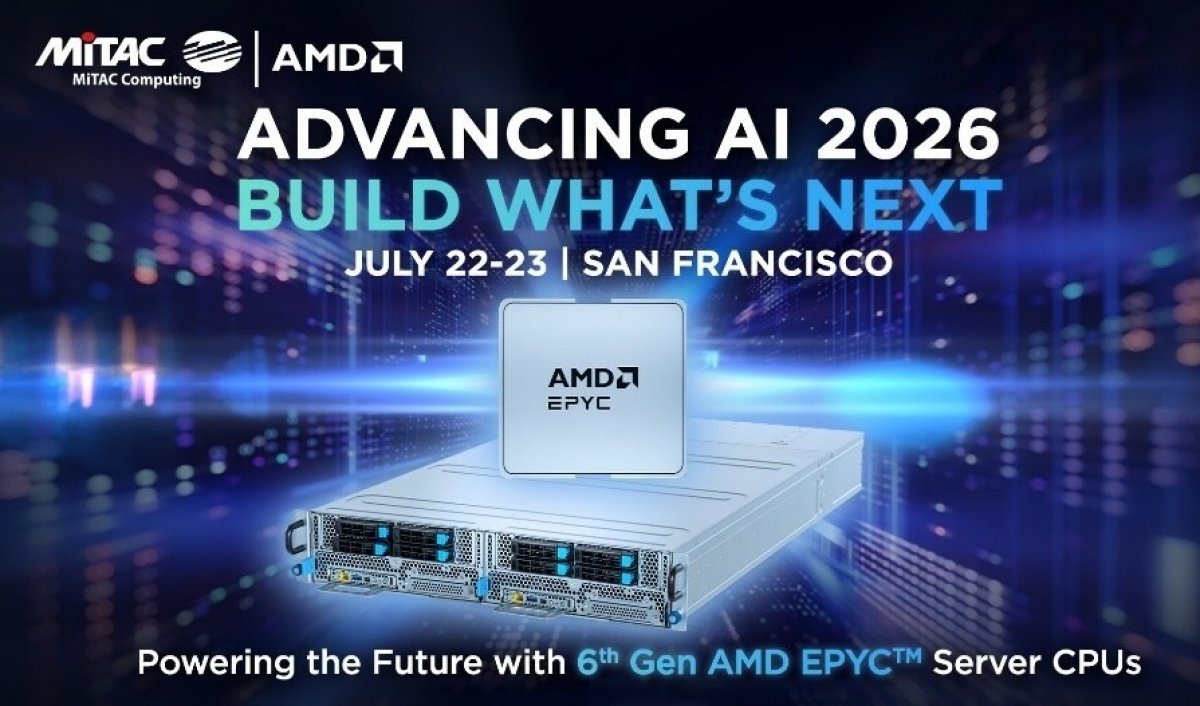
MiTAC Computing is betting that agentic AI workloads, those requiring autonomous, multi-step reasoning rather than single-query responses, demand a CPU architecture rethink before most enterprises have finished their GPU shopping. At AMD’s Advancing AI event, MiTAC unveiled a full infrastructure stack built on 6th Gen AMD EPYC processors, spanning the M2810Z6 and M2610Z6 multi-node servers, a 52U liquid-cooled rack housing up to 96 MI355X GPUs, and a Diamond Cooling server claiming 50% more AI tokens per watt. The throughline is density and efficiency at rack scale, not raw peak performance on a single node.
What this means for your business
The spec sheet here is genuinely consequential for any organization in the middle of a data center refresh cycle. The 50% GPU density gain per rack and the claimed 33% reduction in data center footprint are the numbers a CTO should pressure-test with their facilities team before signing another colocation contract. If those figures hold under real mixed workloads, the rack-scale economics shift the build-versus-buy calculus on private AI infrastructure more than any single chip announcement has in the past two years.
The more interesting move is MiTAC’s framing around agentic AI as an infrastructure category, not just a software one. Agentic pipelines, where AI systems chain together multiple reasoning steps, tool calls, and memory retrievals to complete complex tasks, are memory-bandwidth hungry in a way that pure GPU clusters weren’t designed to accommodate. DDR5-8000 support and CXL 3.1, a high-speed interconnect that lets servers pool memory across nodes as if it were a single large pool, matter here because the bottleneck in an agentic system is often how fast context moves between components, not how fast a single model runs. MiTAC is positioning EPYC as the orchestration layer for that problem, which is a credible technical argument even if the press release dresses it in marketing cadence.
The vendor nobody’s mentioning loudly is Intel. AMD’s EPYC has already taken significant data center CPU share from Intel’s Xeon line, and a platform that bundles MI350X GPUs, EPYC CPUs, and Pensando networking into a single integrated rack offering makes a full-AMD stack easier to justify than it was 18 months ago. The falsification condition for MiTAC’s bet is simple: if agentic workloads in production turn out to be more GPU-bound than memory-bound, the CPU differentiation story collapses and the rack becomes just another dense GPU shelf. That’s the question worth putting to your infrastructure vendor at the next QBR.
Concept deep-dive: CXL (Compute Express Link)
CXL is a high-speed interconnect standard that lets servers share memory across multiple processors or nodes as if the memory were local, similar to how a USB hub lets multiple devices share one port but at data center speeds and latency. It exists because AI workloads are outgrowing what a single server’s memory can hold. For a CTO evaluating agentic infrastructure, CXL 3.1 support means the platform can pool memory across nodes, reducing the need to move large AI context windows across slower network paths.
Based on reporting from MiTAC advances agentic AI infrastructure with AMD EPYC CPUs, originally published 2026-07-24 00:34:00.