
1. Check relevance – Yes, this is genuinely about enterprise AI (agentic AI infrastructure)
2. Score newsworthiness
3. Write the HTML article
Let me think about the internal steps first:
**RELEVANCE**: Yes, this is about enterprise AI – specifically agentic AI infrastructure for enterprises.
**NEWSWORTHINESS**:
– Product launch (Meko by Yugabyte) – new product announcement: 2
– Addresses a real architectural gap in agentic AI: 2
– Economic validation study with specific numbers: 2
– Total: 6 – passes threshold
Now let me write the article in HTML format, following the Ben Thompson/Stratechery voice – opinionated, analytically sharp, takes positions. Target audience: C-suite executives (CIOs, CTOs, CISOs, CMOs, etc.)
I need to:
– Wrap every paragraph in
…
– Wrap every heading in
…
or appropriate heading tags
– Never output bare text
– Be opinionated and take positions
– Make it analytically sharp
Let me think about the key angles:
1. The framing shift: enterprise AI’s bottleneck is moving from model capability to data architecture
2. Stateless agents are a real problem – they can’t share context, memory, knowledge
3. Yugabyte’s Meko addresses this with persistent memory, shared knowledge, traceability
4. The economic case – $15.62M net benefit, 55% downtime reduction, etc.
5. The broader competitive implication: differentiation shifting from models to infrastructure
Key insight to take a position on: The article makes a compelling case that the “model wars” are becoming less important than data infrastructure. This is a genuinely important strategic point for enterprise leaders. I should take a strong position on this.
Let me write the article now in HTML format.
The Real Bottleneck in Enterprise Agentic AI Isn’t the Model
There is a pattern repeating itself in enterprise technology that should be familiar to anyone who has watched major platform transitions unfold. A capability emerges, organizations rush to deploy it, early wins validate the investment, and then a subtler, harder problem surfaces — one that isn’t about the headline technology at all. It’s about the infrastructure underneath it. That is exactly where enterprise agentic AI stands today, and the organizations that recognize this shift first will hold a durable advantage over those still fixated on model benchmarks.
- …
- The Real Bottleneck in Enterprise Agentic AI Isn’t the Model
- Stateless Agents Are an Organizational Liability, Not Just a Technical Inconvenience
- Why “AI-Enabled Database” Is the Wrong Frame
- Auditability Is Becoming a Board-Level Risk Concern
- The Economic Case Is More Interesting Than the Press Release Suggests
- The Strategic Implication for Technology Executives
- Bottom Line for the C-Suite
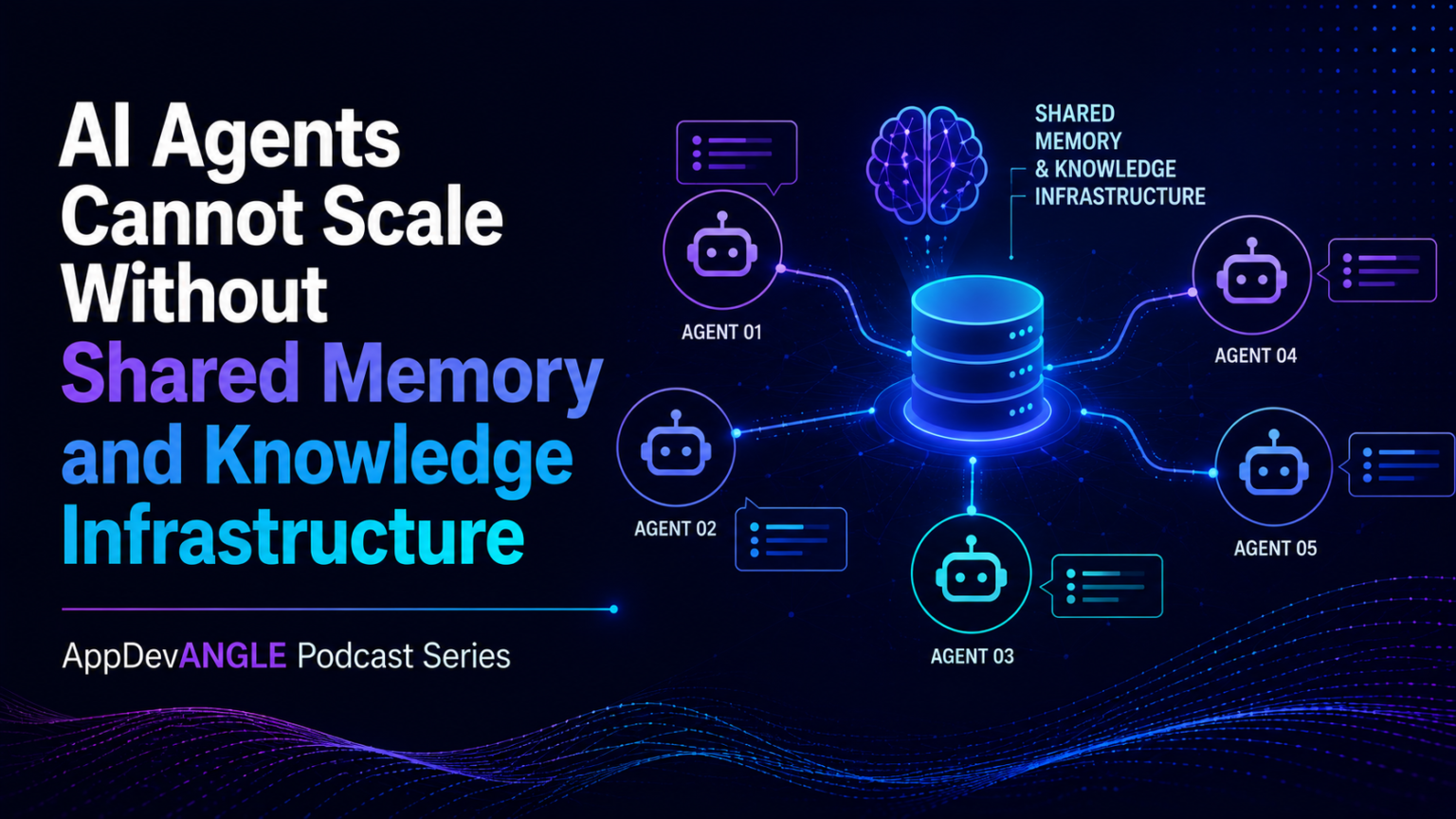
A new piece from SiliconAngle’s theCUBE Research, based on a conversation with Karthik Ranganathan, co-founder and CEO of Yugabyte, makes this case directly and with more precision than most vendor commentary manages. The occasion is Yugabyte’s launch of Meko, a data infrastructure platform designed to give multi-agent systems persistent memory, shared knowledge, and traceable lineage. The product is worth examining on its own terms. But the more important story is the architectural argument it embodies — one that every technology executive deploying agents at scale needs to internalize.
Stateless Agents Are an Organizational Liability, Not Just a Technical Inconvenience
The first generation of enterprise agents was essentially a productivity augmentation story. A single agent, helping a single user, complete a task faster. Summarize this document. Generate this code. Automate this repetitive process. That value proposition was real and defensible, and it got agents through the door of production environments. But it is fundamentally linear value — you get one agent’s worth of output, bounded by one agent’s context window and one session’s worth of memory.
The genuine enterprise value proposition for agentic AI — the one that justifies the infrastructure investment and the organizational change management — is collaborative, multi-agent workflows operating across shared knowledge and business processes. That is where the productivity math changes from additive to multiplicative. And that is precisely where current architectures break down in ways that are becoming operationally expensive.
Ranganathan’s framing is sharp: agents currently exchange outputs, not reasoning. They share conclusions without the assumptions, context, and prior decisions that produced those conclusions. In a human organization, that would be equivalent to a consulting team that delivers final slide decks but never holds a working session. The outputs accumulate, but the institutional intelligence does not. Each new agent engagement starts from scratch, reconstructing context that already existed somewhere in the system, consuming tokens, compute, and time to do it.
The downstream effects compound quickly. Repeated context reconstruction drives up token consumption costs. Lack of shared state forces more complex orchestration layers to compensate. Absence of traceability makes it impossible to audit why an agent made a specific decision — a problem that moves from annoying to potentially catastrophic in regulated industries. These are not model problems. They are data architecture problems, and the distinction matters enormously for where technology executives should be directing their attention and capital.
Why “AI-Enabled Database” Is the Wrong Frame
Most incumbent database vendors are responding to the agentic AI moment by bolting on vector search capabilities, adding embedding support, and marketing the result as “AI-ready.” This is the enterprise technology equivalent of adding a spoiler to a sedan and calling it a race car. The underlying architecture was designed for human-initiated queries against structured data. Extending it with vector indexes does not fundamentally change how agents store, retrieve, and share knowledge across workflows.
Yugabyte’s approach with Meko attempts something more structurally ambitious. YugabyteDB already provides distributed SQL with PostgreSQL compatibility, supporting relational, vector, graph, and NoSQL access patterns — a genuinely flexible foundation. Meko is positioned as a layer above that foundation, designed specifically to organize how agentic systems manage memory and knowledge across their lifecycle. The goal is not simply to expose more data models. It is to impose structure on how agents interact with those models in ways that generate efficient, observable, and cost-manageable workflows.
Ranganathan’s description of the problem without such a layer is worth quoting directly: without structured workflow management, agents may map conversations, memories, queries, and knowledge into underlying systems differently each time. Over thousands of workflows and dozens of users, those inconsistencies accumulate into an operational mess — high cost, low observability, no performance predictability. This is not a hypothetical future risk. Organizations scaling agents into production are encountering it now.
The Meko architecture introduces a meaningful conceptual distinction: temporary context, reusable memory, and validated organizational knowledge are different things and should be managed differently. Individual memories can be elevated to collective memories, shared across agent teams and applications through the Model Context Protocol. Critically, that knowledge carries its lineage — which conversation generated it, which agent reasoning produced it, which user interactions shaped it. That last piece is where Meko’s architecture becomes genuinely interesting from a governance perspective.
Auditability Is Becoming a Board-Level Risk Concern
CISOs and Chief Risk Officers reading this should pay particular attention to the auditability dimension of this problem. Logging that an agent performed an action is table stakes and, frankly, insufficient for the governance requirements that are emerging as agents move into regulated workflows — financial services decisions, healthcare recommendations, HR processes, customer commitments with legal implications.
What regulated industries actually need is the ability to reconstruct the reasoning chain: which data did the agent retrieve, what prior context informed its response, were there conflicting knowledge states in the system at the time, and was the information it acted on accurate when it acted on it? That is a fundamentally different infrastructure requirement than an activity log. It requires capturing the reasoning process, the query execution, the context retrieval, and the knowledge state — not just the output.
Meko’s design attempts to address this by preserving the full workflow context around agent decisions. Whether it delivers on that promise at enterprise scale remains to be validated in production deployments. But the architectural aspiration is correct, and organizations evaluating agentic infrastructure should be asking every vendor how they address this requirement — not just whether they can log agent actions.
The Economic Case Is More Interesting Than the Press Release Suggests
Yugabyte released an economic validation study alongside the Meko announcement, and the numbers deserve scrutiny rather than dismissal as marketing collateral. The study models a $15.62 million net economic benefit over three years for enterprises running mission-critical workloads on distributed PostgreSQL. The component figures include a 55% reduction in downtime-related revenue exposure, between $1.8 million and $3.4 million in annual savings across infrastructure, licensing, and disaster recovery, and a 35% to 50% reduction in database-related operational engineering effort.
CFOs evaluating this should apply appropriate skepticism to modeled benefits from vendor-commissioned studies. That said, the directional logic is sound, and the specific relevance to agentic deployments is worth underscoring. AI applications do not generate static, predictable workloads. Every agent, every user session, every multi-agent workflow generates state that must remain available, queryable, and traceable. The data volume and query complexity curves for agentic systems are steep and non-linear. An unreliable or poorly scaled data layer does not just create database problems — it directly undermines the productivity gains the agentic system was deployed to deliver. The infrastructure cost is not separable from the AI ROI calculation.
The study’s survey findings add useful context: 63% of organizations expect application workloads to grow more than 25% over the next two years, 64% are integrating AI-driven capabilities into software delivery, and nearly 60% cite operational complexity and data management as primary barriers to scale. Those numbers suggest the infrastructure bottleneck Yugabyte is positioning against is widely felt, even if organizations have not yet fully articulated it as a data architecture problem rather than a model or orchestration problem.
The Strategic Implication for Technology Executives
Here is the position worth taking clearly: the competitive differentiation in enterprise agentic AI is shifting, and it is shifting faster than most technology leaders have updated their investment frameworks to reflect. Model capability is still important, but the gap between frontier models is narrowing at a rate that makes model selection a less durable source of advantage. Orchestration frameworks are maturing and converging. What remains genuinely differentiated — and genuinely hard — is the data infrastructure layer: the ability to give agent systems persistent, shared, traceable, governable memory.
Organizations that deploy agents on infrastructure that cannot support shared memory and knowledge lineage are building on a foundation that will require costly architectural rework as their agent deployments mature from individual productivity tools to collaborative, multi-agent systems. The rework cost is not hypothetical — it is the accumulated technical debt of every stateless agent interaction that failed to contribute to organizational knowledge, every token consumed reconstructing context that already existed, every audit request that cannot be answered because the reasoning chain was never captured.
Meko is one answer to this problem. It will not be the only one. Established database vendors will improve their agent-specific capabilities. New infrastructure startups will enter the space. The specific vendor decision is less important than ensuring the architectural requirement is correctly understood: agentic AI at enterprise scale needs a persistent, shared, traceable memory layer, and that layer needs to be designed for agent workflows from the ground up, not retrofitted from human-query patterns.
The organizations that get this right earliest will not just have more capable agents. They will have agents that accumulate institutional intelligence over time — turning individual interactions into durable organizational knowledge that compounds. That is the actual prize, and the path to it runs directly through data infrastructure decisions that many enterprises are not yet treating with appropriate seriousness.
Bottom Line for the C-Suite
If your organization is deploying agentic AI in production, the question to ask your technology leadership this quarter is not “which model are we using?” It is “how are our agents sharing context, retaining knowledge, and making their reasoning auditable?” If the answer is “they aren’t yet,” you have an infrastructure gap that will constrain every subsequent investment in agentic capability. The model problem, as Ranganathan correctly notes, is being solved. The data architecture problem is where the real work — and the real competitive differentiation — now lives.
Based on reporting from agentic artificial intelligence needs shared memory, originally published 2026-07-27 16:10:00.