
Share with your CTO
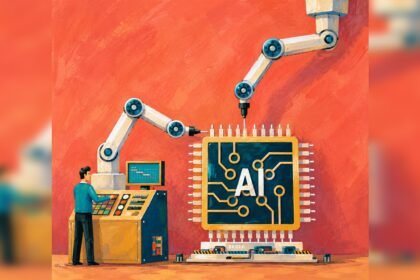
Mexico’s AI-related exports hit a record US$105.8 billion in just the first five months of 2026, overtaking automotive as the country’s top export category, a structural shift driven entirely by surging US demand for AI infrastructure hardware. OpenAI is simultaneously negotiating a US$500 billion, 10-gigawatt data center campus in Ohio backed by Nvidia. On the factory floor, TCS research shows manufacturers moving beyond isolated automation toward enterprise-wide Physical AI, meaning AI embedded directly into robots, sensors, and logistics systems rather than running in a separate software layer above them.
What this means for your business
The scale of OpenAI’s Ohio campus signals something your procurement team should already be modeling: when a single tenant absorbs 10 gigawatts of compute, the hyperscalers building general-purpose cloud regions are not the primary beneficiaries of this capex wave. CTOs who assumed their cloud vendor relationship would abstract them from infrastructure scarcity are facing a harder question. Dedicated, purpose-built AI compute is becoming a distinct market with distinct pricing and availability dynamics, separate from the elastic cloud capacity they’ve budgeted against.
Mexico’s export flip from cars to servers is the supply-chain consequence of that same infrastructure wave, and it has a second-order effect that most enterprise architecture teams are ignoring. The components flowing through Mexican manufacturing into US data centers, boards, cabling, specialized server chassis, represent a concentration of physical dependency that mirrors the semiconductor concentration risk the industry spent three years trying to resolve. The TCS Physical AI readiness data compounds this: as manufacturers embed AI into factory hardware rather than software, disruptions to that hardware supply chain propagate into production systems, not just IT systems.
The BCG CMO finding that only one-third of marketing organizations have actually redesigned their operating models for AI despite near-universal belief that transformation is coming is the same pattern playing out at the infrastructure layer. Awareness is not architecture. CTOs who’ve acknowledged the compute shift but haven’t stress-tested their vendor and capacity assumptions against a world where OpenAI-scale tenants crowd out spot availability will find that budget cycle, not strategic intent, decides where they end up. The leading indicator to watch isn’t Nvidia’s next GPU announcement; it’s whether your hyperscaler’s reserved capacity commitments are being honored on the timelines you were promised.
Concept deep-dive: Physical AI
Physical AI refers to AI models and inference engines, the systems that run trained models in real time, deployed directly inside physical hardware like robotic arms, conveyor sensors, and autonomous forklifts, rather than in a cloud application the hardware calls out to. Think of it as the difference between a car that asks a remote server for navigation and one with the map burned into the chip. The business consequence is that hardware procurement and AI strategy, previously separate budget lines, become the same decision.
Based on reporting from Physical AI, Infrastructure Runs Mexico’s Growth Road, originally published 2026-07-30 17:09:00.