
Share with your CTO
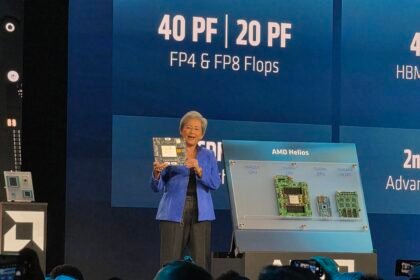
AMD is arguing that agentic AI infrastructure breaks the GPU-first model that defined the last four years of data center buildout. Where current AI deployments run one CPU for every four to eight GPUs, AMD’s technical analysis published in mid-2026 puts the right ratio for agentic workloads at 1:1, or even CPU-heavy. The company is backing that claim with shipping hardware: the EPYC 9005 series at 192 cores today, and the “Venice” architecture at 256 cores on the near-term roadmap, alongside Instinct accelerators and Pensando networking.
What this means for your business
Every data center architecture decision made during the GPU gold rush assumed that raw model inference was the dominant workload. Agentic AI, systems that coordinate multiple sub-agents simultaneously, manage tool calls, parse live data, and act on results, looks nothing like that. The compute bottleneck shifts from floating-point throughput to parallel process orchestration, which is CPU territory. If your infrastructure team hasn’t already pressure-tested that assumption, the 1:1 ratio claim is the right forcing function to do it now.
AMD is the vendor making this argument, and it sells server CPUs, so the incentive to declare a CPU renaissance is obvious. That framing plausibly inflates the urgency of the ratio shift and understates the degree to which GPU-side orchestration offloads could absorb some of this demand. But the underlying logic doesn’t require AMD to be right about every workload to matter. Even a move from a 1:8 ratio to a 1:4 ratio across a large agentic deployment doubles the CPU procurement line, and current data center contracts almost certainly weren’t written with that headroom in mind.
The procurement decision most exposed here isn’t next year’s GPU order. It’s the CPU refresh cycle already in flight. Organizations locking multi-year server contracts at legacy ratios are building capacity debt against a workload profile that’s shifting under them. If agentic deployments scale faster than the refresh cycle turns, the gap between contracted infrastructure and actual compute needs becomes a real architectural liability, not a planning footnote. I’d revise that concern downward only if GPU-side scheduling advances make orchestration overhead largely disappear, and there’s no credible roadmap for that today.
Concept deep-dive: CPU-to-GPU ratio
In a modern AI server, the CPU handles coordination tasks, the operating system, memory management, and routing data, while the GPU handles the heavy matrix math inside AI models. The ratio describes how many CPUs sit alongside each GPU. A 1:8 ratio means one CPU manages eight GPUs, which works when the GPU is constantly busy on a single large task. Agentic workloads fragment into dozens of simultaneous smaller tasks, overwhelming a single CPU coordinator, which is why AMD argues the ratio needs to collapse toward 1:1.
Based on reporting from AMD’s push into agentic AI demands a complete rethink of data center architecture, originally published 2026-07-23 13:13:00.