
Share with your CIO
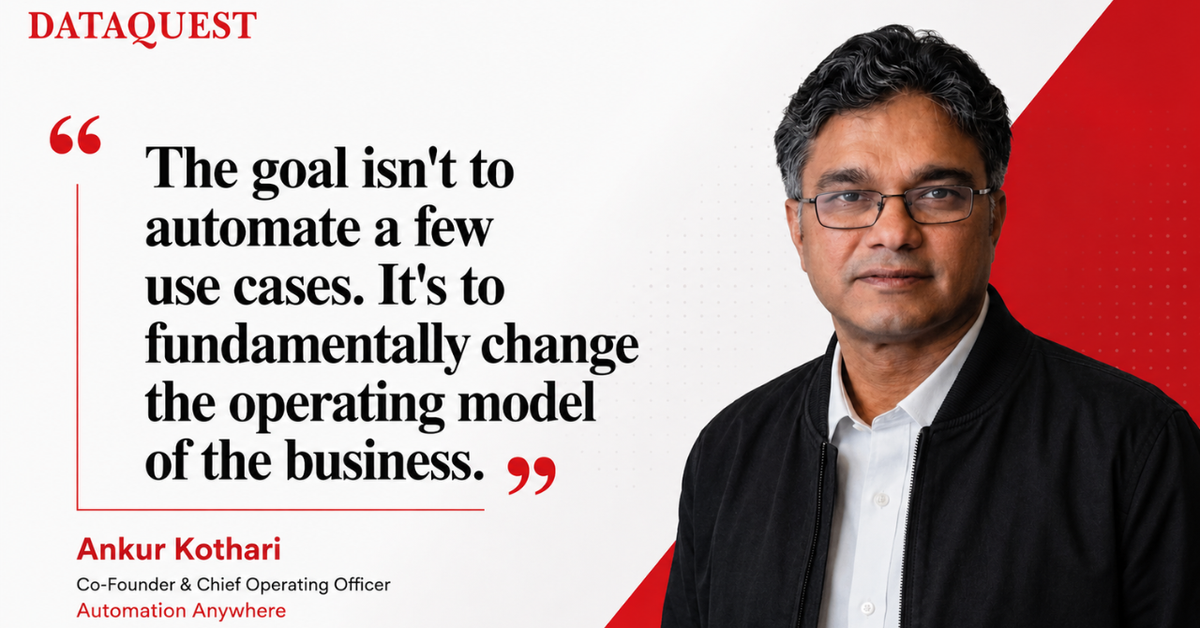
Automation Anywhere is repositioning its entire business around what COO Ankur Kothari calls agentic process automation, the orchestration of AI agents across enterprise systems end-to-end rather than within any single platform. Kothari claims 80% of current customer engagements now center on agentic automation, and that more than 90% of pilot deployments advance to production. The company’s 2030 vision targets 50% to 80% of business-critical processes running autonomously, with every knowledge worker becoming three times more productive through AI assistance rather than replacement.
What this means for your business
The vendor landscape for enterprise automation has quietly split into two camps, and which camp your current contracts sit in will define your architecture options for the next five years. Platform vendors like Salesforce, ServiceNow, and Microsoft are building AI agents that work best inside their own data boundaries. Automation Anywhere is betting CIOs will refuse that lock-in and pay for a separate orchestration layer that spans all of them. If your processes already cross three or more enterprise systems, that bet may be your bet too, whether you’ve made it consciously or not.
The 90%-pilots-to-production claim deserves scrutiny, and not just because Automation Anywhere, as a vendor selling into this narrative, has a structural incentive to report optimistic adoption curves. The more interesting question is what “production” means in these deployments. A single AI agent processing IT helpdesk tickets is production. Autonomous order-to-cash across ERP, CRM, and a logistics platform is a different category entirely. Kothari doesn’t distinguish between them, which means CIOs should press hard on comparable case evidence before treating that 90% figure as a signal about their own readiness horizon.
The framing that genuinely warrants budget attention is the decoupling argument. Kothari’s claim that automation should let enterprises grow revenue without proportionally growing software licensing costs is a direct challenge to how every major SaaS vendor prices today, typically per seat or per consumption unit. If autonomous agents replace human interactions with software, per-seat pricing collapses as a cost model. CIOs who are currently renewing large enterprise agreements with Salesforce, SAP, or ServiceNow should be modeling what agent-driven usage does to their license utilization, because the vendors certainly are.
Concept deep-dive: Agentic process automation
Traditional RPA, robotic process automation, executes fixed rules on predictable inputs, think copying data between two systems on a schedule. Agentic process automation adds an AI reasoning layer that can handle variation, make conditional decisions, and call other tools or agents to complete a workflow. The analogy is the difference between a vending machine and a junior analyst who knows when to escalate. The business relevance is that it extends automation’s reach into processes that previously required human judgment at every exception.
Based on reporting from ‘The Real Goal Is Enterprise Autonomy’: Automation Anywhere’s Ankur Kothari on AI’s Next Chapter, originally published 2026-08-02 10:19:00.