
Share with your CDO
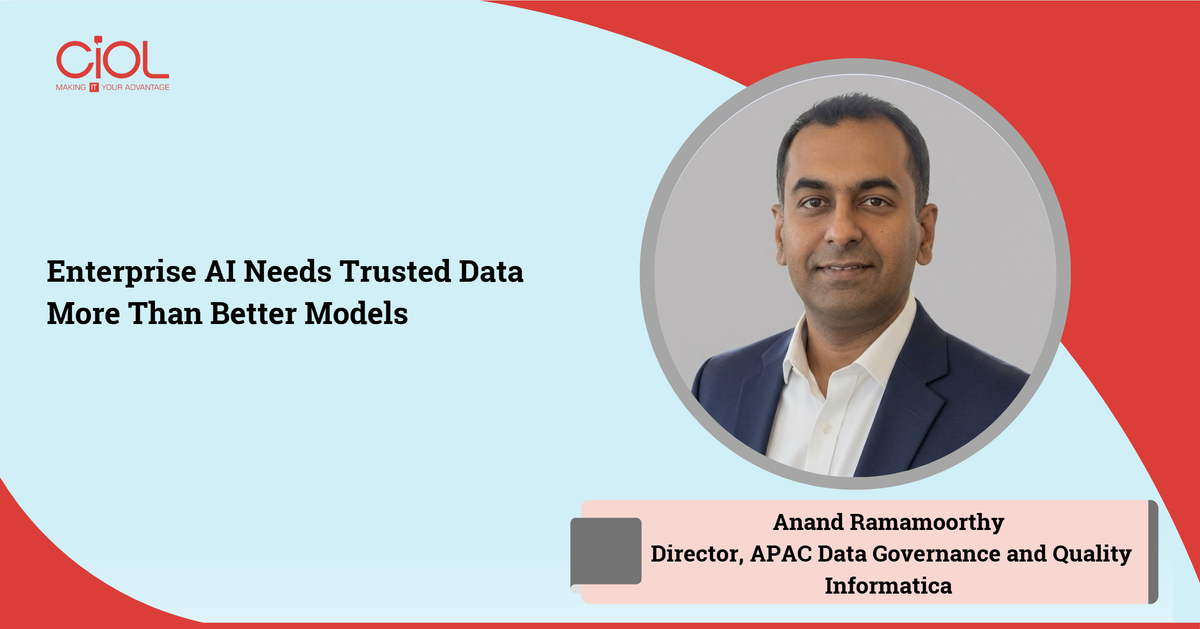
Salesforce’s $8 billion Informatica acquisition is a bet that enterprise AI stalls without a governed data layer underneath it, and Anand Ramamoorthy, Informatica’s APAC Director of Data Governance and Quality, makes that case directly in this interview on enterprise data strategy. The architecture he describes positions Salesforce as the activation surface for AI agents while Informatica handles metadata, quality, and compliance, including India’s DPDP Act. MuleSoft connects the pipes. The combined platform is pitched as a unified data-to-AI stack that still operates across heterogeneous, multi-vendor enterprise environments.
What this means for your business
The story that decides whether this interview is about you is whether your AI programs are already hitting data quality walls. If your agents are returning inconsistent outputs, or your governance team is still manually classifying data, you’re exactly the organization Ramamoorthy is describing. If your data foundation is already mature and vendor-agnostic, this is a competitive benchmark, not a call to action. The dividing line isn’t budget or industry; it’s whether your data layer was built before or after AI became a production workload.
Ramamoorthy’s core claim, that AI amplifies data quality problems rather than compensating for them, is correct and worth treating seriously. The recurring failure mode in enterprise AI deployments is that organizations treat model selection as the primary variable and discover too late that fragmented metadata, inconsistent business term definitions, and unclassified sensitive data are the actual bottlenecks. An AI agent querying five systems that each define “customer” differently doesn’t produce a smarter answer; it produces a confidently wrong one. The governance-as-foundation argument isn’t new, but agentic AI, where systems act autonomously rather than just generate text, makes the cost of bad data structural rather than cosmetic.
The frame worth holding here is that Ramamoorthy works for a company whose commercial case depends on enterprises believing that governance infrastructure is non-negotiable, which tilts his timeline for urgency optimistically and his treatment of build-versus-buy alternatives toward silence. That doesn’t make the argument wrong. It does mean the “data governance as house foundation” analogy quietly skips the question of whether Informatica specifically is that foundation, or whether a well-run data mesh, a modern data catalog from a different vendor, or a tighter Snowflake and dbt stack might serve the same role at lower integration cost. CDOs evaluating this should pressure-test the heterogeneous-environment claim in particular. Salesforce has a strong incentive to make Informatica indispensable to Agentforce adoption, and “works across all your systems” is the promise every platform makes before the contract is signed.
The real budget pressure this creates isn’t a new data governance purchase; it’s the renewal or expansion decision on your existing data catalog and quality tooling. If you’re already licensed for something in this stack, the Salesforce-Informatica integration gives you a reason to consolidate rather than extend. If you’re not, the AI agent rollout your CIO is pushing for 2025 is about to surface exactly the data quality debt this interview describes, and whoever gets blamed for the delay will be whoever owns the data layer. That’s the CDO’s calculus to make now, not after the first agent failure reaches the board.
Concept deep-dive: Machine-readable metadata
Metadata is data about data, the label that tells a system what a field means, where it came from, who can see it, and how reliable it is. “Machine-readable” means that context is structured so an AI agent can consume it automatically, without a human explaining it first. Think of it as the difference between a filing cabinet with handwritten sticky notes and one with a searchable index. Without it, AI agents operating across multiple systems have no reliable way to resolve ambiguities like whether two “revenue” fields mean the same thing.
Based on reporting from Enterprise AI Needs Trusted Data More Than Better Models: Informatica’s Anand Ramamoorthy, originally published 2026-08-02 23:30:00.