

Share with your CTO
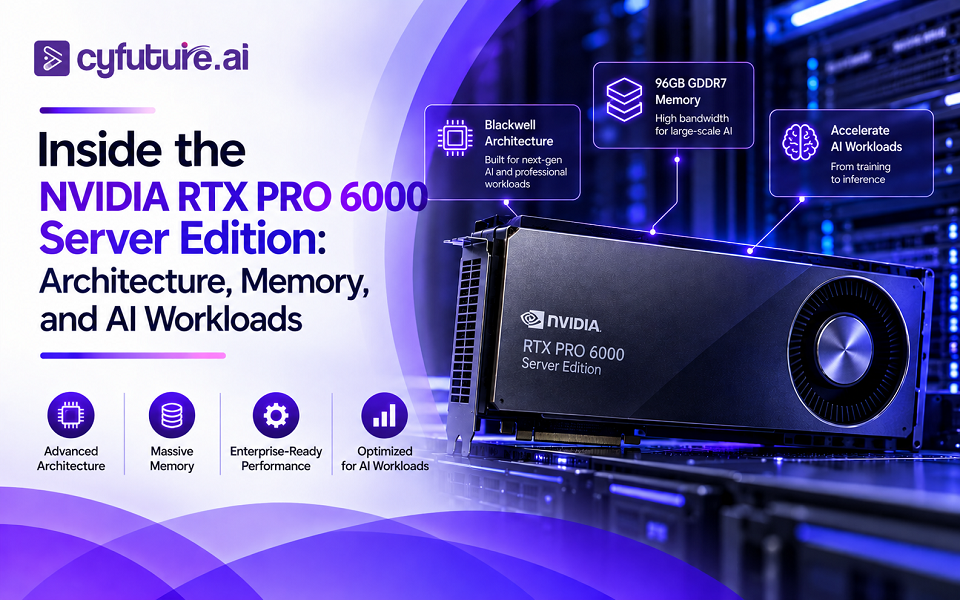
NVIDIA is positioning its RTX PRO 6000 Blackwell Server Edition as a single-card answer to the sprawling, multi-accelerator AI infrastructure problem. The card ships with 96GB of GDDR7 ECC memory, 1,597 GB/s of memory bandwidth, and configurable power up to 600W, all in a passive-cooled form factor built for dense server racks. Its Blackwell Tensor Cores hit 4 PFLOPS at FP4 precision. MIG support allows the card to split into up to four isolated 24GB instances, meaning one physical GPU can serve multiple concurrent workloads.
What this means for your business
Whether this card belongs in your infrastructure roadmap depends less on its spec sheet and more on where your AI workloads currently break down. Organizations running large language model inference that keeps hitting GPU memory ceilings, or teams doing fine-tuning that requires awkward model-parallelism splits across multiple cheaper cards, sit squarely in the addressable problem. Organizations already running H100-class clusters optimized for training at scale are a different story entirely.
The MIG capability deserves more attention than it typically gets in GPU announcements. The recurring failure mode in enterprise GPU procurement is buying for peak workload and running at 30% utilization the rest of the time, because the card is too coarse-grained to share cleanly between teams. Four isolated 24GB partitions from a single 96GB card means an infrastructure team can allocate GPU resources the way it allocates CPU cores or storage volumes, matching capacity to actual demand rather than worst-case demand. That changes the unit economics of a shared AI platform meaningfully, and it’s the argument that should be driving the conversation with your CFO, not the raw FLOPS number.
The RTX PRO 6000’s real differentiation is the workload convergence play, not AI performance alone. It handles inference and fine-tuning alongside ray-traced rendering, digital twins, and engineering simulation on the same silicon. If your organization is running separate GPU clusters for visualization teams and AI teams, that’s a consolidation opportunity worth modeling. I’d revise that assessment if NVIDIA’s MIG implementation here proves less stable under mixed workload conditions than the cleaner HGX architectures, which remain the safer bet for pure AI throughput at scale.
Concept deep-dive: Memory bandwidth
Memory bandwidth measures how fast data moves between a GPU’s memory pool and its compute cores, expressed in gigabytes per second. Think of it as the width of the pipe feeding the engine: a powerful engine starved of fuel runs slow regardless. AI inference is especially sensitive to this constraint because generating each token in a language model requires loading billions of parameters repeatedly. High bandwidth, 1,597 GB/s here, keeps compute cores fed and prevents the GPU from waiting on its own memory.
Based on reporting from NVIDIA RTX PRO 6000 Server Edition: Architecture, Memory, and AI Workloads | nasscom, originally published 2026-09-09 00:47:00.