

Share with your CTO
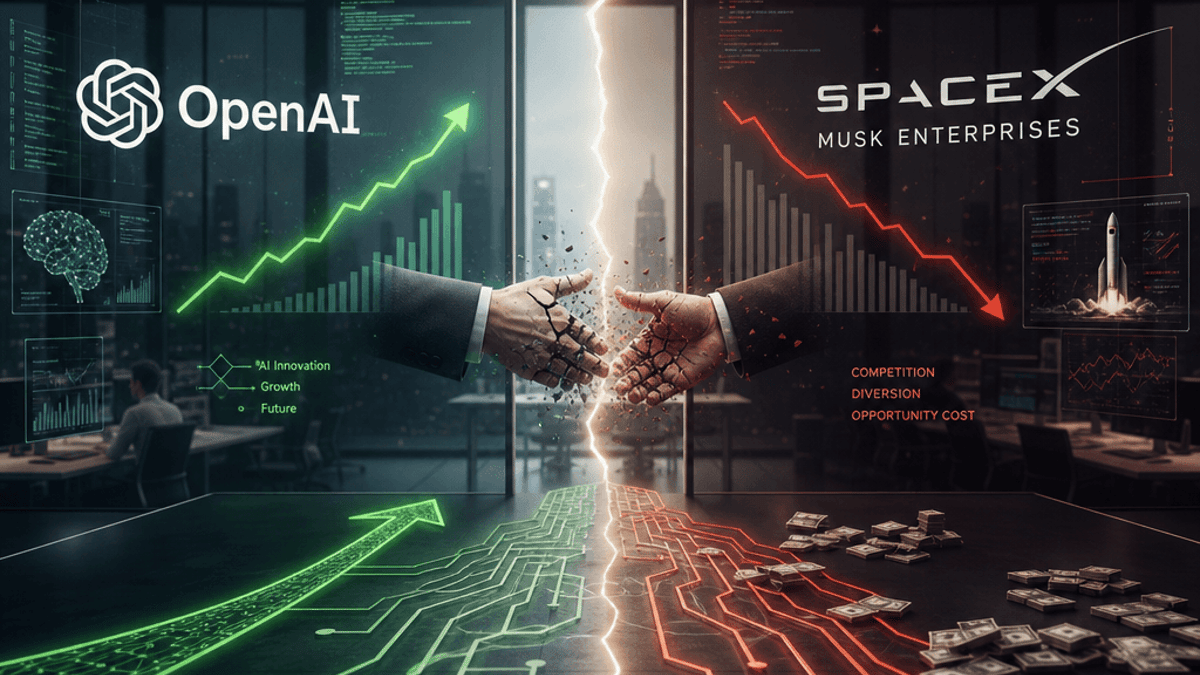
OpenAI walked away from a partnership with Cursor, the AI coding assistant built by Anysphere, after Elon Musk’s SpaceX acquired the company. The decision cost OpenAI an internally estimated $1 billion-plus in projected annual revenue. According to Wired, OpenAI’s leadership determined that routing nine figures of revenue into a Musk-controlled entity, given his active litigation against the company and his competing xAI venture, crossed a strategic line the business wasn’t willing to hold. The Cursor partnership termination leaves Cursor’s enterprise and individual user base in limbo and opens real displacement risk for one of the developer productivity market’s fastest-growing tools.
What this means for your business
If your engineering organization is running Cursor in production, you have a dependency problem right now. The model backend that powered Cursor’s core functionality is gone, and SpaceX has not confirmed what replaces it. The likely candidate is xAI’s Grok, a model with far less enterprise track record than OpenAI’s GPT-4 class offerings. Any team that deployed Cursor for code review, generation, or documentation workflows needs to audit exposure before the product’s capabilities degrade or its roadmap pivots to serve SpaceX’s internal needs first.
The deeper pattern here is what you could call vendor-as-collateral-damage: your chosen AI tool gets caught in a rivalry between foundation model providers, and your workflows absorb the disruption. This is structurally different from a vendor going bankrupt or getting acquired by a competitor. OpenAI didn’t lose to GitHub Copilot on product merits. It chose to exit. That means the risk calculus for any AI developer tool now includes not just the vendor’s financial health, but the ownership graph sitting above it. A single-model-provider dependency on any coding assistant is harder to defend after this.
The signal worth watching: whether Cursor’s enterprise customer base migrates to GitHub Copilot or Replit’s Ghostwriter, or whether OpenAI uses this moment to accelerate its own coding-native product to recapture the segment it just vacated. If OpenAI launches or acquires a Cursor competitor within the next 12 months, the walk-away starts looking less like a concession and more like a market repositioning. The question is whether your engineering stack can tolerate the uncertainty in the meantime.
Based on reporting from OpenAI Walks From $1B Cursor Deal Over Musk, originally published 2026-09-03 13:14:00.