


Share with your CFO
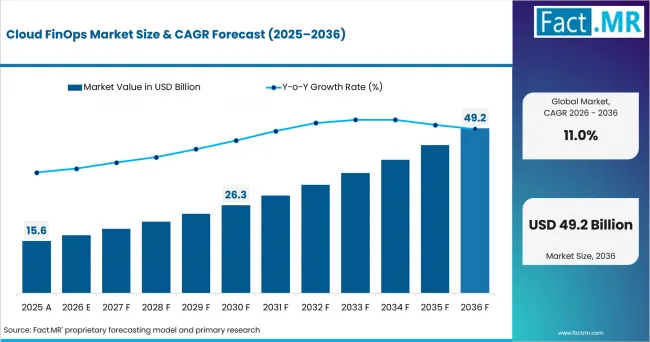
The Cloud FinOps market is growing fastest where cloud sprawl and engineering headcount are growing fastest, with India leading at a 12.8% CAGR through 2036, followed by China at 12.1%, Australia at 10.8%, the UK at 10.5%, and the US at 10.3%. The US and UK numbers look modest only relative to Asia-Pacific, not relative to market maturity. AI workload expansion, distributed engineering teams, and government digitization programs are each independently generating demand for tools that connect infrastructure consumption to budget owners.
What this means for your business
The story here isn’t which country grows fastest. It’s that the unit driving FinOps adoption in every region is the same: a distributed engineering organization spending cloud budget without centralized visibility into who owns what. If your firm runs product or platform teams across more than one geography, and those teams provision infrastructure independently, you’re already inside this problem whether or not you’ve named it. The question isn’t whether FinOps tooling matters; it’s whether your current approach scales to AI workloads, which compound the allocation problem fast.
AI is the specific accelerant that changes the calculus. A traditional web application has relatively predictable compute costs. A platform running multiple AI workloads, sharing GPU clusters across teams, and billing back to business units creates an attribution problem that spreadsheets and manual tagging genuinely can’t solve at scale. The UK data point is the clearest signal: 91% of AI-using firms in the 2023 ONS survey also used cloud systems, which means almost every organization scaling AI is simultaneously scaling the cost-visibility problem FinOps tools exist to address.
The CFO who waits for engineering to bring this forward will get it too late. The allocation gap between when AI infrastructure gets provisioned and when finance understands what it cost tends to widen during platform build-out phases, exactly when budget discipline matters most. Fact.MR sells into the market it’s projecting, so the growth rates carry optimistic shading, but the underlying driver, AI workloads multiplying shared infrastructure costs, is structurally real. I’d revise this view only if enterprise AI adoption stalls significantly, which would slow FinOps demand for the same reason it would slow cloud spend overall.
Concept deep-dive: Cloud FinOps
Cloud FinOps, short for cloud financial operations, is the practice of connecting cloud infrastructure spending to the teams and products that caused it. It exists because cloud billing is usage-based and instantaneous while corporate budgeting is periodic and centralized, creating a gap where costs accumulate faster than anyone notices. The analogy is an expense account with no receipts required. The business connection is direct: without FinOps tooling, AI workloads running on shared infrastructure become the largest unattributed line item in the technology budget.
Based on reporting from Cloud FinOps Market, Growth and Forecast 2036, originally published 2026-07-09 03:00:00.