

Share with your CMO
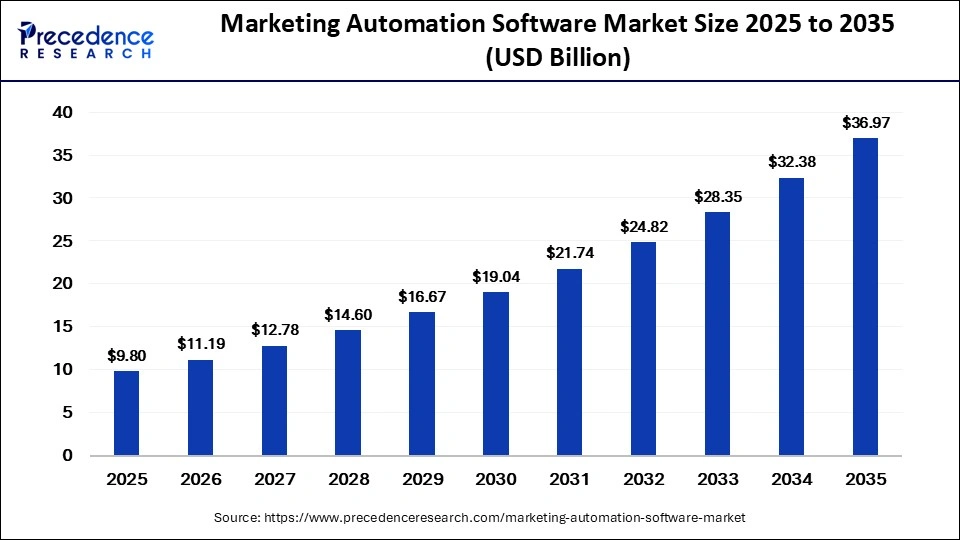
The marketing automation software market is on track to nearly quadruple from $9.8 billion in 2025 to $37 billion by 2035, compounding at 14.2% annually. Cloud-based platforms already command 75% of deployments, SMEs are the fastest-growing buyer segment at a 17% CAGR, and customer journey orchestration, the capability that coordinates messaging across every channel in real time, is outpacing every other application category at 18.5% growth. Asia Pacific is accelerating fastest. Adobe’s April 2026 CX Enterprise launch and Treasure Data’s Marketing Super Agent signal that agentic AI, systems that act autonomously rather than just assist, is the next battleground.
What this means for your business
The number that deserves attention is not the headline CAGR but the SME growth rate beating large enterprise adoption by 4.5 points. That inversion matters because it signals the cost and complexity barriers that historically kept sophisticated automation exclusive to Fortune 500 marketing stacks are collapsing. If you run marketing at a mid-market company and your automation stack still looks like a 2019 deployment, you are no longer protected by the assumption that only big-budget teams can field these tools. Your competitors are arriving.
The fastest-growing application segment, customer journey orchestration, is worth sitting with. This is not email scheduling or A/B testing. It means a platform that ingests a customer’s in-store visit, cross-references their app behavior, and fires a personalized offer before they reach the checkout, without a human in the loop. The vendors shipping this capability, Adobe, Treasure Data, and a growing set of challengers, are pitching it as a replacement for the campaign-by-campaign planning cycle that most marketing teams still run. Whether that pitch holds depends entirely on data integration quality, which is exactly where legacy CRM and CDP, customer data platform, connections break down in practice.
The real pressure point this data surfaces is the renewal conversation with your current platform vendor. Customer journey orchestration is commanding 18.5% growth while email automation, the core of most existing contracts, is declining in share from 20% to 18% by 2035. That divergence is a leading indicator of where pricing power is moving inside the vendor stack. CMOs heading into platform renewals in 2025 or 2026 should weight orchestration capability and agentic AI roadmap credibility more heavily than they weight current email deliverability benchmarks, because the contract you sign today will still be running when those capabilities define competitive parity.
Concept deep-dive: Agentic AI in marketing
Agentic AI refers to systems that pursue goals autonomously, making sequential decisions, like reallocating ad spend mid-campaign or suppressing a message after detecting a service outage, without waiting for human approval. Think of it as the difference between a navigation app that shows you traffic and one that reroutes the car while you focus elsewhere. In marketing, the business implication is that campaign execution shifts from a human-supervised workflow to a supervised-autonomy model, which changes headcount assumptions and accountability structures simultaneously.
Based on reporting from Marketing Automation Software Market Companies, Size & Trends 2026-2035, originally published 2026-09-09 20:58:00.