

Share with your CIO
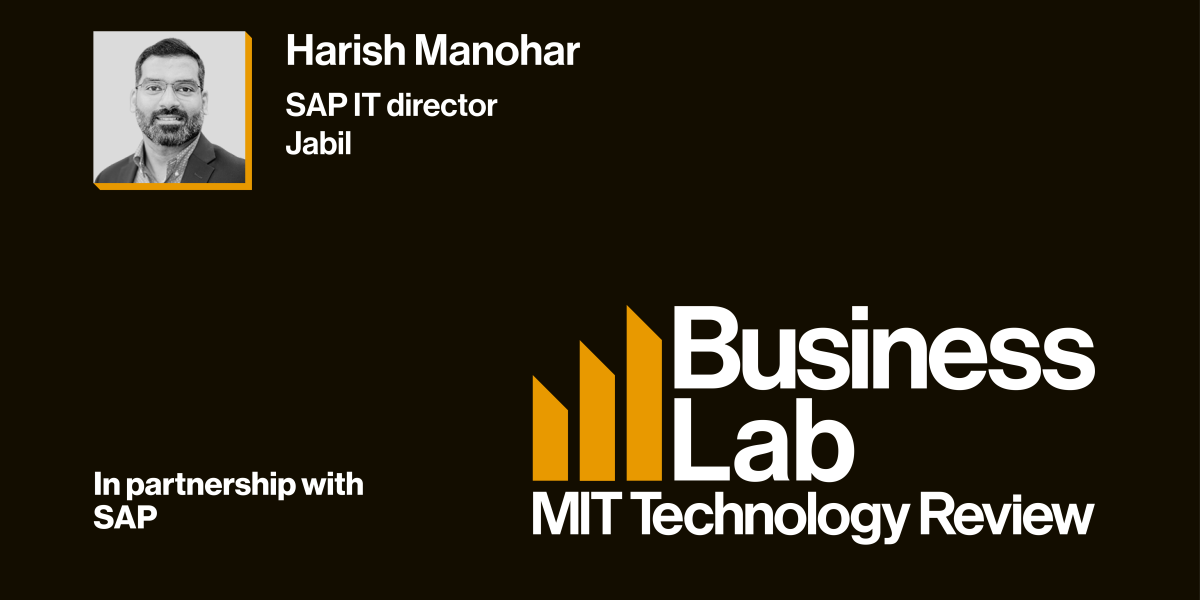
Jabil, the global contract manufacturer running 100-plus plants across multiple regulated industries, is betting that integration infrastructure has to precede AI, not run alongside it. In a conversation published by MIT Technology Review, Jabil’s IT leadership describes building end-to-end data pipelines across supply chain, planning, and inventory as the foundation for any future automation or AI workload. SAP’s Business Technology Platform and Signavio process management tool are the named instruments. The strategic framing is blunt: simplicity and consolidation are competitive assets at scale, not housekeeping tasks.
What this means for your business
The organizations that will feel this argument most sharply are complex manufacturers or diversified industrials running heterogeneous plant networks with legacy ERP sprawl. If your AI roadmap is already live but your data pipelines are still site-specific, patchworked, or dependent on spreadsheet handoffs between systems, Jabil’s sequencing logic is a direct challenge to your architecture. The question isn’t whether AI is valuable; it’s whether you’ve built the substrate that makes AI outputs trustworthy enough to act on at speed.
The recurring failure mode in large-scale AI programs looks like this: a compelling proof-of-concept in one plant or one business unit, followed by 18 months of painful attempts to replicate it elsewhere, stalled by local customizations, inconsistent data definitions, and governance gaps that nobody mapped before the pilot launched. Jabil’s approach, standardizing workflows and data flows first through tools like Signavio, is designed specifically to defuse that replication problem. The cost is upfront standardization discipline across sites with different regulatory regimes and maturity levels, which is genuinely hard, and Harish acknowledges they’re not at 100%. But the payoff is that new tooling can be deployed without rebuilding the integration layer every time.
The vendor picture here matters. SAP’s BTP and Signavio represent a deliberate consolidation bet, trading ecosystem flexibility for deployment speed. That’s a real tradeoff. If your organization has already consolidated around SAP, this architecture argument reinforces staying the course. If you’re running a mixed landscape with Salesforce, Oracle, or homegrown systems at the plant level, the harder question is whether the standardization dividend is worth the migration cost, and that answer lives in your total number of integration touchpoints, not your AI ambition level. I’d revise this framing if Jabil publishes deployment timelines showing the standardization phase took longer than the AI rollout it enabled.
Concept deep-dive: Business process management
Business process management, or BPM, is the practice of documenting, standardizing, and governing how work actually flows across an organization, think of it as drawing the real map of how a purchase order or a quality inspection moves from trigger to completion, then enforcing that map digitally. It exists because large organizations accumulate local workarounds that diverge from intended process design. The business connection to AI is direct: AI systems trained or operating on inconsistent process inputs produce inconsistent outputs, making BPM a prerequisite, not a parallel track.
Based on reporting from Facilitating AI integration with simplicity at scale, originally published 2026-09-02 10:00:00.