
Share with your CIO
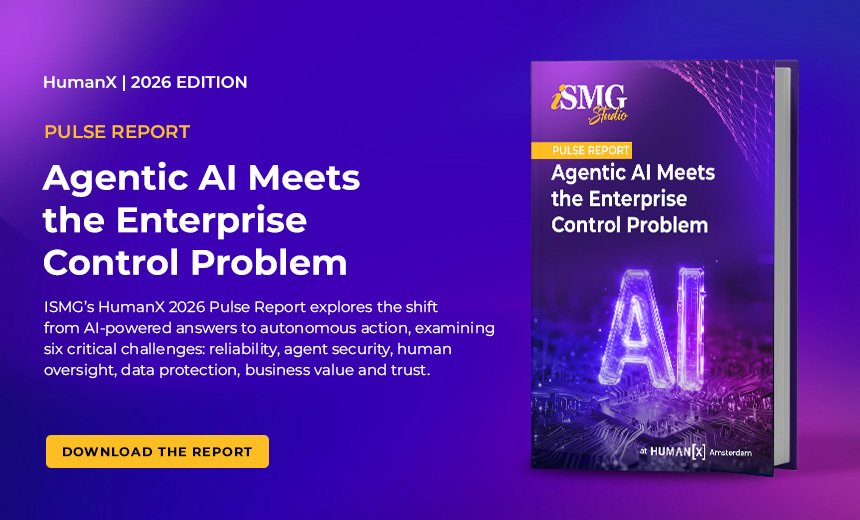
Enterprises deploying AI agents are running into a control problem they didn’t fully price in at the pilot stage. ISMG’s Pulse Report from HumanX Amsterdam 2026 synthesizes interviews with executives from OpenAI, AWS, IKEA, Philips, and others to argue that the next competitive gap won’t come from model capability but from governance infrastructure. Agents need scoped credentials and dedicated digital identities, human oversight must be calibrated to decision reversibility, and enterprise context, the proprietary data and institutional knowledge an organization already holds, is becoming both the moat and the liability.
What this means for your business
The organizations most exposed here aren’t the ones that haven’t started with AI agents; they’re the ones that have. A successful pilot masks a structural problem. Agents that perform well across thousands of test interactions can fail catastrophically at millions, because small error rates compound into operational disasters at scale. If your organization has moved an agent into production without establishing what decisions require a human stop, you’re not ahead of this issue, you’re inside it.
The report’s most pointed finding is one that rarely surfaces in vendor conversations: model access is no longer the differentiating factor. What separates organizations that extract durable value from those stuck cycling through proofs of concept is the unglamorous work of workflow redesign and measurable outcome definition. Agents dropped into existing processes don’t redesign those processes. They accelerate whatever was already there, including the inefficiencies. The competitive advantage the report describes belongs to organizations that treat agent deployment as an operating model question, not a technology procurement question.
Worth watching is the identity layer problem. AI agents accessing sensitive systems need something analogous to employee credentials, with scope limits, audit trails, and revocation capability, but most enterprise identity and access management infrastructure was built for humans. Retrofitting it for autonomous software workers is a real architectural lift, and organizations that solve it early will have a meaningful advantage when regulators eventually mandate it. The falsification condition for this whole thesis is straightforward: if a major enterprise demonstrates sustained agent performance at scale without dedicated governance infrastructure, the report’s framing collapses. Until that happens, the governance-first argument holds.
Concept deep-dive: Scoped credentials
Scoped credentials are access permissions granted to a specific system or agent that are intentionally limited to only what that system needs to complete its task, similar to giving a contractor a key that opens one room rather than the whole building. For AI agents that autonomously execute transactions or retrieve sensitive data, scoped credentials contain the blast radius of a compromise or misbehavior. Without them, a single compromised agent can traverse an organization’s data environment without a natural stopping point.
Based on reporting from ISMG Pulse Report: Agentic AI Meets Enterprise Control, originally published 2026-10-26 19:26:00.