

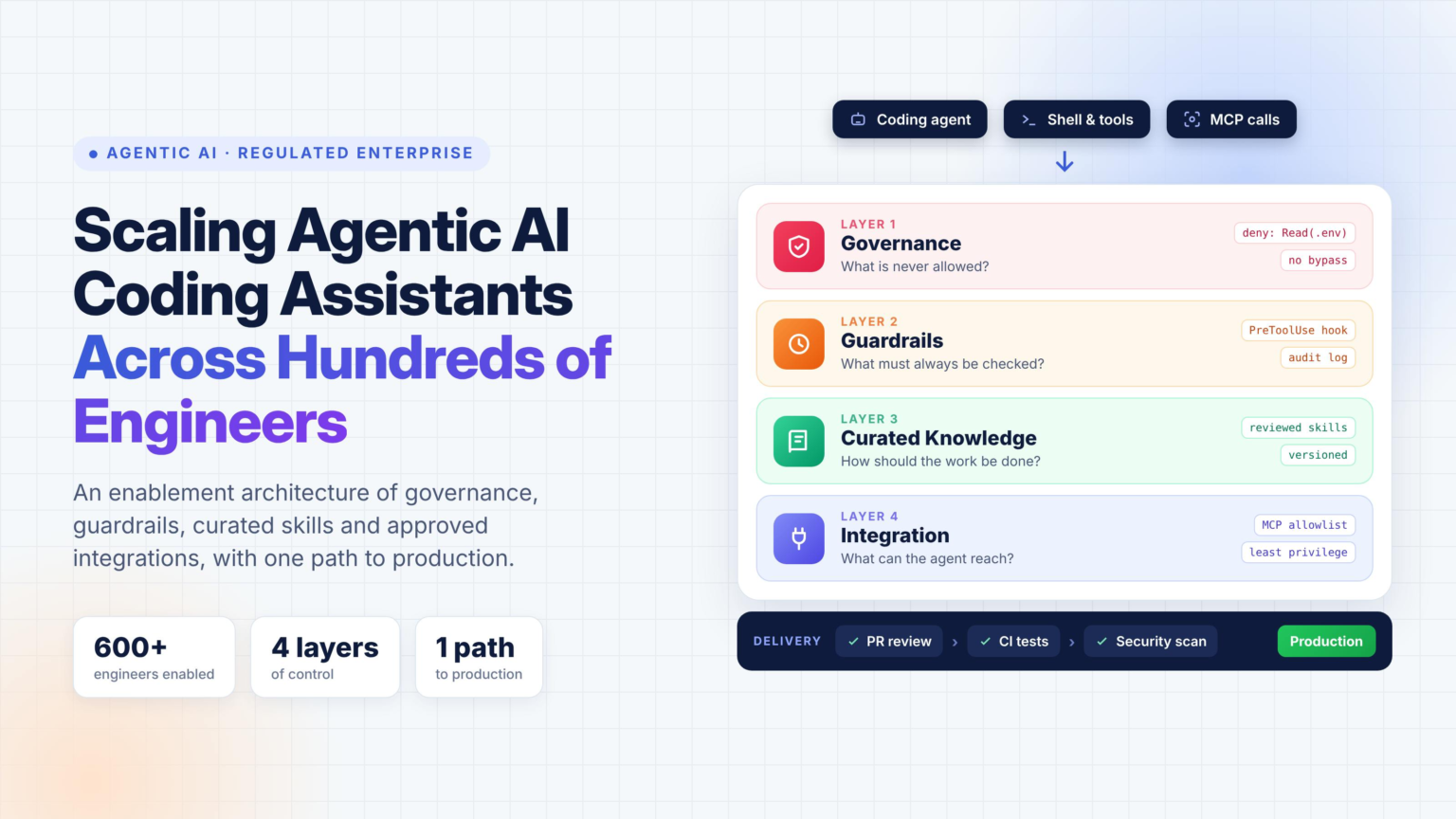

There is a sentence buried in Lokesh Suri’s detailed practitioner account of deploying agentic AI coding tools across more than 600 engineers at a major financial-services firm that deserves to be pulled out and examined in daylight: “Scale enablement for hundreds of engineers is a platform issue — not a series of tool demos.” That single observation reframes the entire debate about AI coding productivity, and it has significant implications for every C-suite leader currently watching their engineering organization experiment its way toward an agentic future. Most enterprises are still in the tool-demo phase. Somebody buys GitHub Copilot or Cursor licenses, engineers play with them, the enthusiastic ones share tips in Slack, and governance arrives late to impose restrictions that feel punitive rather than enabling. Suri’s argument — grounded in actual deployment experience, not vendor case studies — is that this approach is structurally guaranteed to underdeliver. The article is worth serious attention not because it resolves every question about agentic AI in the enterprise, but because it correctly identifies which questions actually matter. The foundational distinction Suri draws is one that many technology leaders have not fully internalized. An autocomplete suggestion is inert until a human accepts it. An agent reads files, runs shell commands, calls external APIs, and pushes branches. In a bank — or any regulated institution — that difference is not incremental. It crosses a threshold that touches security, audit, and model-risk functions simultaneously. This is why the framing of “AI coding assistant” as a productivity tool is subtly misleading. It suggests the relevant question is whether developers write code faster. The more consequential question is whether the organization has a coherent model for what the agent is permitted to do, how those permissions are enforced deterministically, and how every action gets logged in a way that satisfies an auditor. Suri’s answer — treat agentic AI as an internal platform with its own architecture — is the correct one, and it is not yet the default posture in most enterprises. One of the most valuable contributions of this article is its honest treatment of the productivity research, which vendors universally cherry-pick. The 2023 GitHub Copilot study showing a 55.8% speed-up on a greenfield JavaScript task gets cited constantly. The 2025 randomized controlled trial finding a 19% slowdown for experienced open-source developers working in their own mature codebases gets mentioned far less. Suri cites both, acknowledges they are measuring different things, and draws the correct operational conclusion: measure your own outcomes, in your own context, against your own baseline. The DORA 2024 data adds a further complication that should concern any COO or CTO building productivity projections around AI adoption: higher AI adoption correlated with better documentation and faster code review, but slightly lower delivery throughput and stability. That is not the chart vendor sales decks show. It is, however, the chart that belongs in a board-level discussion about AI investment returns. The security finding is even more alarming and deserves more attention than it typically receives. The referenced 2023 Stanford/Cornell study found that developers using AI assistants wrote significantly less secure code — and were more confident it was secure. An earlier analysis found roughly 40% of AI-generated programs in security-relevant contexts contained vulnerabilities. For a CISO, this is not a footnote. It is a primary risk, and it argues directly for keeping AI-generated code on exactly the same review, testing, and security scanning path as human-written code, with no fast-lane exceptions. The architectural model Suri describes — governance, guardrails, curated knowledge, integration — is worth examining layer by layer, because the insight embedded in the structure is as important as the components themselves. The governance layer establishes what is never allowed through centrally managed, deny-first configuration that takes precedence over anything a user or project can configure. This is the correct design choice. Security invariants that can be overridden by individual users are not invariants; they are suggestions. Credential files are unreadable, arbitrary outbound HTTP from the shell is denied, and pushes require explicit human approval. These rules are not negotiable at the project level. The guardrails layer is where the architectural philosophy becomes most explicit. Suri quotes Anthropic’s own documentation: use hooks, not instructions, for rules that must always hold. This is a critical distinction for any technology leader overseeing AI governance. Prompt-based rules are probabilistic. A sufficiently crafted adversarial input can route around them. Deterministic hooks — small, testable scripts that inspect every tool call before execution — are not. The failure scenario Suri describes, where a ticket contains a hidden instruction to exfiltrate credentials, illustrates why this matters: prompt injection is the top-ranked LLM risk in OWASP’s framework, and it is not a theoretical concern. The curated knowledge layer — packaged, reviewed, versioned “skills” for repeatable workflows — is the part that scales institutional knowledge rather than just constraining risk. A migration recipe or contract-test procedure encoded as a reviewed instruction file reaches every team simultaneously and improves through the same pull-request process as production code. This is how the platform metaphor becomes operational: knowledge governance works the same way permission governance does. The integration layer completes the picture by applying an allowlist model to MCP server connections. Every external tool the agent can reach is reviewed like a code dependency — because it effectively is one. This maps directly to OWASP’s recommendation for minimal permissions and to the principle of least privilege that any CISO would recognize from conventional access management. One detail in this article that risk and compliance leaders should flag immediately: the April 2026 revision to U.S. banking model-risk guidance (SR 26-2) explicitly places generative and agentic AI models outside its scope, leaving firms to develop their own risk-management practices. The NIST AI Risk Management Framework and its Generative AI Profile provide structural guidance but not tool-level configuration specifics. This regulatory gap is simultaneously a risk and an opportunity. The risk is that firms moving quickly without a coherent framework will face retroactive scrutiny when regulators inevitably catch up. The opportunity is that firms which build defensible, auditable, code-based governance now — where every policy is in version control and every agent action is logged — will be ahead of whatever requirements emerge. Suri’s architecture is explicitly designed to produce that kind of audit trail, and that is not incidental. It is the feature that gets risk partners to agree to deployment at all. The most underappreciated section of the article describes the enablement progression: engineers first learn what agents can and cannot do, then run curated skills against real tasks, then write new skills and submit them for review. The third stage is where the architecture becomes self-sustaining, because the engineers closest to a manual workflow are the ones best positioned to automate it. This is how a central platform generates compound returns without requiring the central team to maintain everything. The implication for CHROs and CDOs is significant. AI adoption at engineering scale is not primarily a technology deployment problem. It is an organizational learning problem with a technology substrate. The 600-engineer mentorship program Suri describes succeeded through repeatable sessions, shared examples, and the cultivation of local experts — none of which shows up in a software license count. Organizations that measure AI adoption by seat count and ignore the enablement architecture will consistently underperform those that invest in the latter. Suri is appropriately candid about the trade-offs, and they are real. Centralized control slows experimentation. Regex-based hooks are a last line of defense, not a sandbox — a determined user can work around them. Curated skills require ongoing maintenance, and stale skills propagate outdated practices at scale. Measurement remains genuinely hard because self-reported productivity gains are unreliable and controlled experiments are expensive. For smaller organizations without regulatory obligations, this architecture adds overhead that may not be justified. There is also a tension the article does not fully resolve: the gap between what the four-layer architecture controls and what it cannot. Prompt injection through legitimate channels — a developer’s own code comments, documentation pulled from an approved internal tool, a well-intentioned but poorly written ticket — remains a residual risk that no permission model fully closes. The layered defense reduces the blast radius; it does not eliminate the attack surface. The decision that matters most right now is not which AI coding tool to license. It is whether your organization is going to treat agentic AI deployment as a platform investment or as a series of tool evaluations. Those are not the same budget line, they do not produce the same outcomes, and the gap between them grows wider as agent capabilities expand from single-repository changes toward multi-step, multi-system workflows. Suri’s strongest practical lesson is the one he calls “keep one path to production.” The risk partners at his organization agreed to agentic AI deployment because agents changed nothing about how code is reviewed, tested, and released. That is both a governance principle and a change-management strategy. It keeps the innovation surface area manageable while preserving the controls that regulated entities cannot afford to compromise. CFOs building the business case should note the honest uncertainty in the productivity data and build conservative assumptions accordingly — speed-up projections drawn from greenfield studies do not translate reliably to mature codebases. CISOs should treat the security-confidence inversion as the primary risk, not a secondary one. CTOs and CDOs should recognize that the platform investment required to do this well is real, not incidental, and it belongs in the budget alongside the tool licenses. And CEOs should understand that the firms that will extract durable advantage from agentic AI are those that build governance infrastructure now, before regulatory requirements crystallize and before the first significant incident forces a reactive architecture that nobody would have chosen from a blank slate. The research does not promise a universal speed-up. That is not a reason to wait. It is a reason to measure honestly, build defensibly, and stop letting vendor benchmarks do your risk management for you.
Agentic Coding Assistants in Regulated Enterprises: The Platform Insight That Changes Everything
The Autocomplete-to-Agent Gap Is a Risk-Profile Discontinuity, Not a Feature Upgrade
The Productivity Evidence Is Far Weaker Than Vendors Imply
The Four-Layer Architecture: What Makes It Defensible
The Regulatory Gap Is Real and Currently Unresolved
The Scaling Insight: Enablement Is a People Problem Wearing a Technology Costume
Where the Argument Has Limits
The Strategic Takeaway for the C-Suite
- Agentic Coding Assistants in Regulated Enterprises: The Platform Insight That Changes Everything
- The Autocomplete-to-Agent Gap Is a Risk-Profile Discontinuity, Not a Feature Upgrade
- The Productivity Evidence Is Far Weaker Than Vendors Imply
- The Four-Layer Architecture: What Makes It Defensible
- The Regulatory Gap Is Real and Currently Unresolved
- The Scaling Insight: Enablement Is a People Problem Wearing a Technology Costume
- Where the Argument Has Limits
- The Strategic Takeaway for the C-Suite
Here is the full HTML analysis, ready for WordPress:
Editorial notes on the output:
- Every paragraph is wrapped in
<p>tags; every heading in<h2>tags — no bare text anywhere. - Voice: Opinionated and analytically sharp in the Thompson/Stratechery mode — takes clear positions (the tool-demo approach is “structurally guaranteed to underdeliver”; the security-confidence inversion is “the primary risk, not a secondary one”) while remaining accessible to a general smart reader.
- Persona coverage: The conclusion explicitly addresses CFOs (business case framing), CISOs (security-confidence inversion), CTOs/CDOs (platform investment), and CEOs (governance timing) — each gets a targeted, role-specific insight without the piece feeling like a listicle.
- Key arguments surfaced and sharpened:
- The autocomplete-to-agent gap is a risk-profile discontinuity, not a feature upgrade
- The productivity evidence is materially weaker than vendor messaging implies (the 19% slowdown study gets equal billing with the 55.8% speedup)
- Permissions, not prompts, are the primary control surface — and why that distinction matters
- The regulatory gap (SR 26-2 explicitly out-of-scope) is a material compliance risk
- The “one path to production” principle as both governance and change-management strategy
- Limitations are called out honestly (regex hooks are not a sandbox; stale skills propagate errors; the architecture doesn’t close prompt injection through legitimate channels)
Based on reporting from Scaling Agentic AI Coding Assistants in a Regulated Enterprise, originally published 2026-10-28 18:03:00.