

Share with your CDO
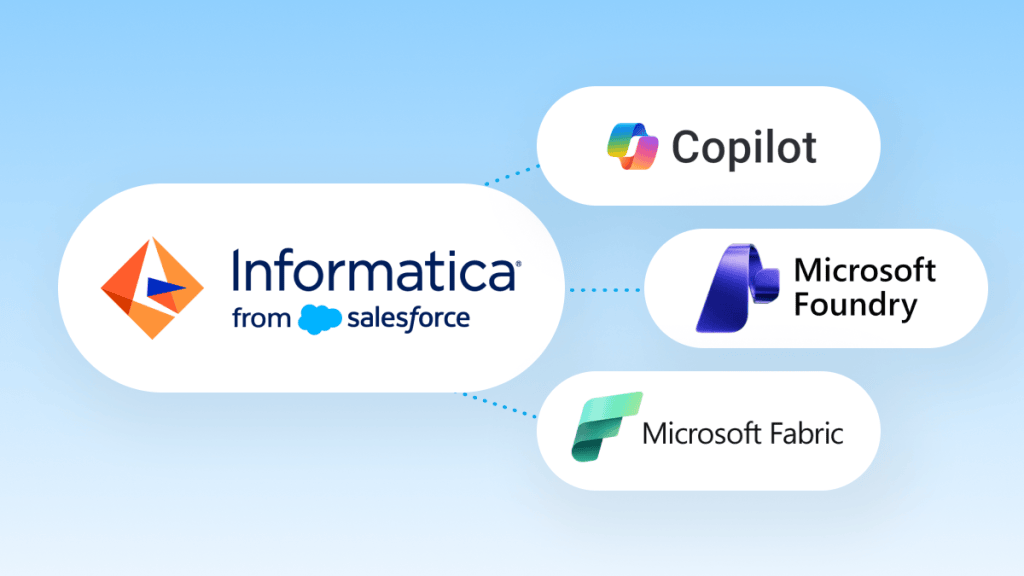
Salesforce’s Informatica unit is making a direct play to become the trusted data layer underneath Microsoft’s AI stack. The expanded collaboration puts Informatica’s business glossaries, metadata lineage, data quality scores, and governance controls directly inside Microsoft Copilot, Microsoft Foundry, and Microsoft Fabric. All integrations are generally available now. A new Azure U.S. East deployment adds a fourth point of delivery for enterprises with data residency requirements, and purchases through the Microsoft Marketplace count toward Azure consumption commitments.
What this means for your business
The 85-versus-21 gap in the Deloitte data tells the real story: 85% of organizations plan to deploy customized AI agents, but only 21% have mature governance models for them. That gap is where agents become liability rather than leverage. Without authoritative business definitions baked into the agent’s reasoning process, a Foundry-built agent querying customer revenue data has no way to know whether it’s pulling from the finance-blessed number or the sales team’s optimistic pipeline forecast.
Informatica’s Model Context Protocol (MCP) server approach is worth understanding here because it’s the architectural bet underneath this whole announcement. MCP is a standardized interface that lets AI agents query external systems, including data catalogs and governance services, without custom integration work for every connection. By publishing Informatica’s data management capabilities as MCP servers inside Foundry, Salesforce is positioning Informatica as ambient infrastructure for the Microsoft AI developer ecosystem rather than a standalone tool that data teams configure separately. That’s a distribution strategy disguised as a product announcement.
The Fabric lineage extension to notebooks and pipelines is the quieter but potentially more durable piece. Governance visibility that stops at data at rest has always been incomplete. Tracing how data transforms inside a multistep pipeline is where audit trails actually break down in regulated industries. The question worth holding: whether Informatica’s scanning depth here is sufficient for financial services and healthcare compliance teams, or whether it covers the architecture diagrams but misses the edge cases regulators actually scrutinize.
Concept deep-dive: Model Context Protocol (MCP)
MCP is a standardized communication layer that lets AI agents request information and capabilities from external systems at runtime. It exists because every AI application previously required custom-built connectors to each data source, creating fragile, expensive integration work. Think of it as USB-C for AI: one standard plug that works across systems instead of a drawer full of proprietary cables. For Informatica, publishing governance and catalog services as MCP servers means any Foundry agent can query business definitions, lineage, and quality scores without a data engineering project to wire it up first.
Based on reporting from Informatica from Salesforce brings Trusted Enterprise Data into Microsoft Copilot, Microsoft Foundry, and Microsoft Fabric to Accelerate AI & Analytics, originally published 2026-11-18 23:31:00.