
Share with your CTO
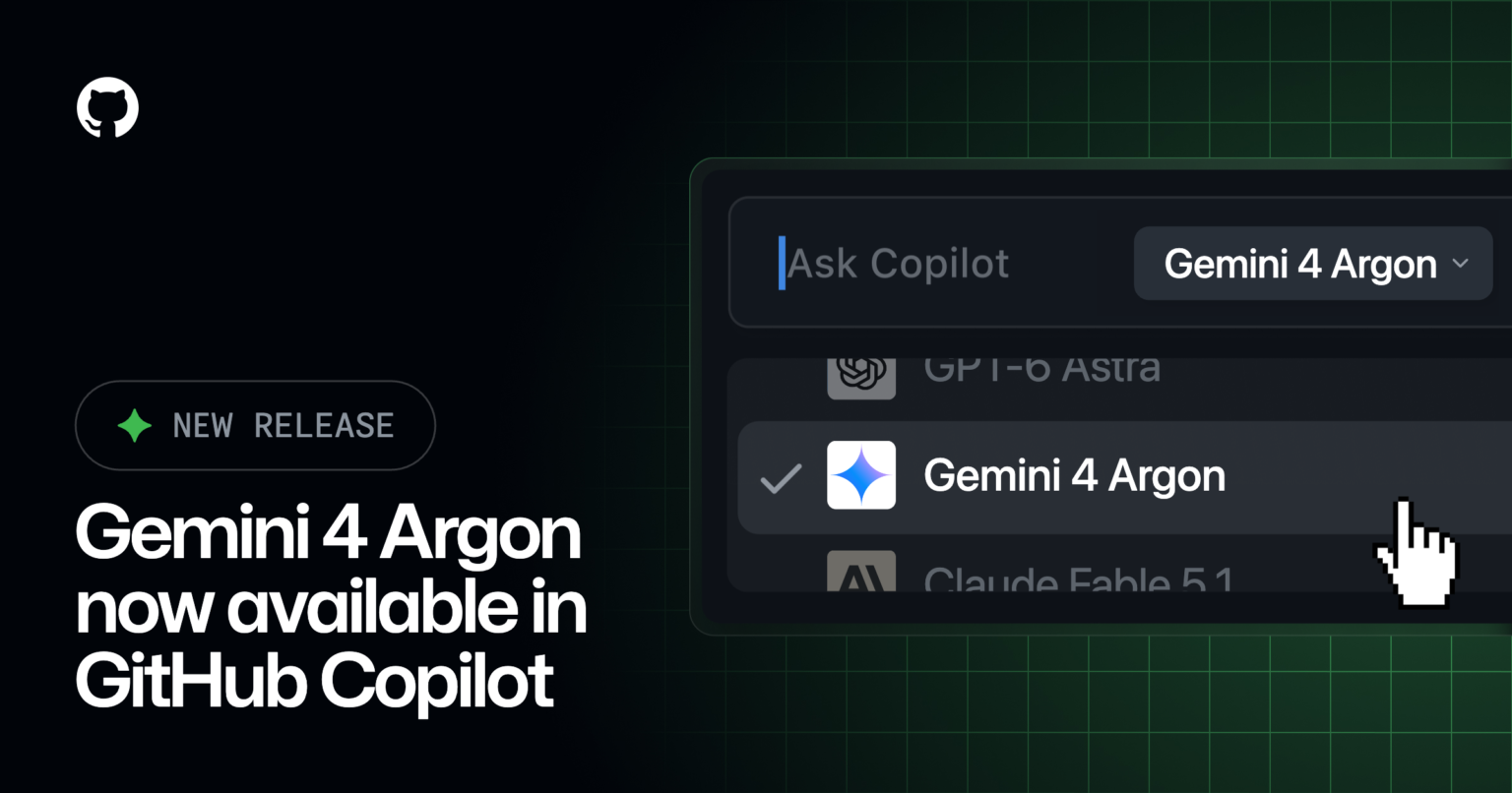
GitHub is pushing Google’s newest frontier model directly into the hands of enterprise developers. Gemini 4 Argon in GitHub Copilot is now generally available to Copilot Pro+, Max, Business, and Enterprise subscribers across every major IDE, including VS Code, JetBrains, Xcode, and Eclipse, as well as the Copilot CLI and coding agent. Google claims the model outperforms every prior Gemini release on coding benchmarks, with the sharpest gains in the CLI context. It’s billed at provider list pricing under usage-based billing, meaning costs scale with consumption rather than seat count.
What this means for your business
The pricing structure is the detail most CTOs will underestimate. Usage-based billing at provider list pricing means a team that adopts Gemini 4 Argon aggressively for agentic workflows, where the model autonomously runs tasks, tests edge cases, and iterates without human prompting at each step, can generate a cost curve that looks nothing like a traditional software seat license. You need consumption telemetry before you greenlight broad rollout, not after.
The benchmark claim that deserves scrutiny is the CLI performance gain. The command-line interface is where developers run automation scripts, scaffold infrastructure, and chain tool calls together. A model that solves more agentic tasks in that context isn’t just a better autocomplete engine. It’s a candidate for replacing human-authored runbooks and reducing toil in CI/CD pipelines. That’s a different category of productivity claim than “writes code faster,” and it warrants a structured pilot rather than a casual toggle in the model picker.
The model policy controls for Enterprise and Business admins, where new models auto-enable unless explicitly blocked, deserve immediate attention. The default-on posture means Gemini 4 Argon could already be live in your environment without a deliberate decision by your team. The signal worth watching: whether Google’s model access inside Microsoft’s developer platform accelerates the multi-model architecture that enterprise engineering orgs are quietly building, or whether it creates a governance headache when different teams are running different models against the same codebase.
Concept deep-dive: Agentic coding
Agentic coding describes AI that doesn’t just respond to a single prompt but executes multi-step tasks autonomously: writing code, running tests, catching failures, and revising output before surfacing a result. The analogy is a junior developer who doesn’t ask for approval after every line but returns with a finished pull request. It exists because LLM reliability on complex tasks improves dramatically when the model can self-correct across iterations. For CTOs, the business implication is that agentic models touch compute, security boundaries, and code review workflows simultaneously, requiring governance that single-prompt tools never demanded.
Based on reporting from Gemini 4 Argon in GitHub Copilot, originally published 2026-10-13 14:39:00.