
Share with your CIO
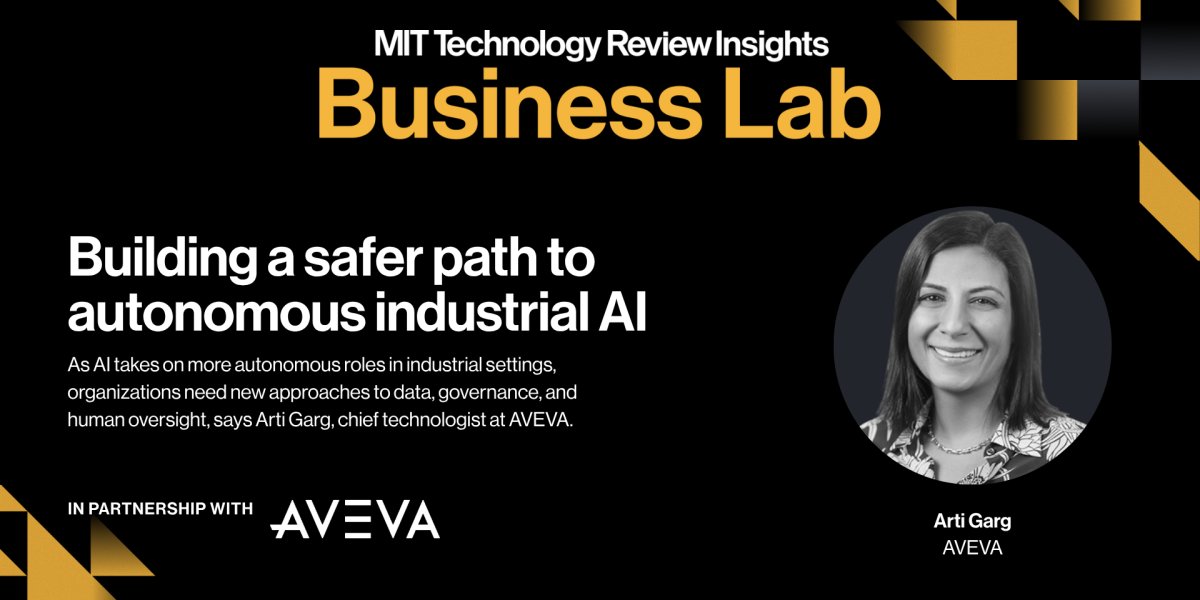
AVEVA is betting that the next competitive gap in industrial operations opens at the intersection of agentic AI and physical safety constraints. In a conversation with MIT Technology Review, AVEVA’s chief product officer Arti lays out a three-part responsible AI mandate covering security, environmental efficiency, and human oversight, then pivots to the workforce math that makes this urgent: nearly half the industrial workforce retires within five years, taking decades of site-specific operational knowledge with them. The argument is that agentic AI can capture and transfer that tacit expertise faster than any apprenticeship model.
What this means for your business
The companies most exposed here are not the ones running outdated equipment. They’re the ones whose operational continuity depends on a small cohort of senior engineers who know, from experience, why a particular pump behaves oddly at 3am in February. If that knowledge lives only in human memory, the retirement wave is a structural risk that no hiring plan fully addresses. Industrial CIOs who have not yet framed this as a knowledge-capture problem, distinct from a headcount problem, are already behind the planning cycle.
AVEVA’s framing of agentic AI as an experience-transfer mechanism is genuinely interesting, though it arrives from a vendor whose product roadmap benefits directly from customers accepting that framing. The specific tilt worth watching: AVEVA emphasizes the opportunity of models that “learn by doing” and port that learning across sites, while treating the explainability deficit of modern AI as a challenge to manage rather than a hard constraint. That is an optimistic read. A reasoning model that updates its own behavior over time, controlling physical systems in a refinery or a mine, is not simply a faster apprentice. It is a system whose failure modes may not surface until the conditions that trigger them appear in production, which in industrial settings can mean injuries, not just downtime.
The governance architecture AVEVA describes, a joint framework covering both internal AI use and customer-facing deployment, with human judgment kept in critical decision loops, is the right structural instinct. But “human in the loop” is doing a lot of work in that sentence. A CIO evaluating any industrial AI platform right now should press vendors hard on where exactly the human checkpoint sits, what triggers it, and what the system does when the human is unavailable. Those answers will separate platforms with genuine oversight design from platforms with oversight as a positioning slide. I’d revise this view if a major industrial AI deployment demonstrated autonomous fault recovery in a live hazardous environment with no safety incident, because that would show the explainability gap is smaller than current evidence suggests.
Concept deep-dive: Agentic AI
Agentic AI refers to systems that pursue multi-step goals autonomously, deciding on their own which actions to take next rather than waiting for a human prompt at each stage. Think of it as the difference between a calculator and a junior analyst who can run an analysis, notice something odd, pull more data, and flag a conclusion unprompted. In industrial settings, the business stakes of that autonomy are categorically higher because the actions connect to physical equipment, not just digital outputs.
Based on reporting from Building a safer path to autonomous industrial AI, originally published 2026-10-08 04:17:00.