
Share with your CEO
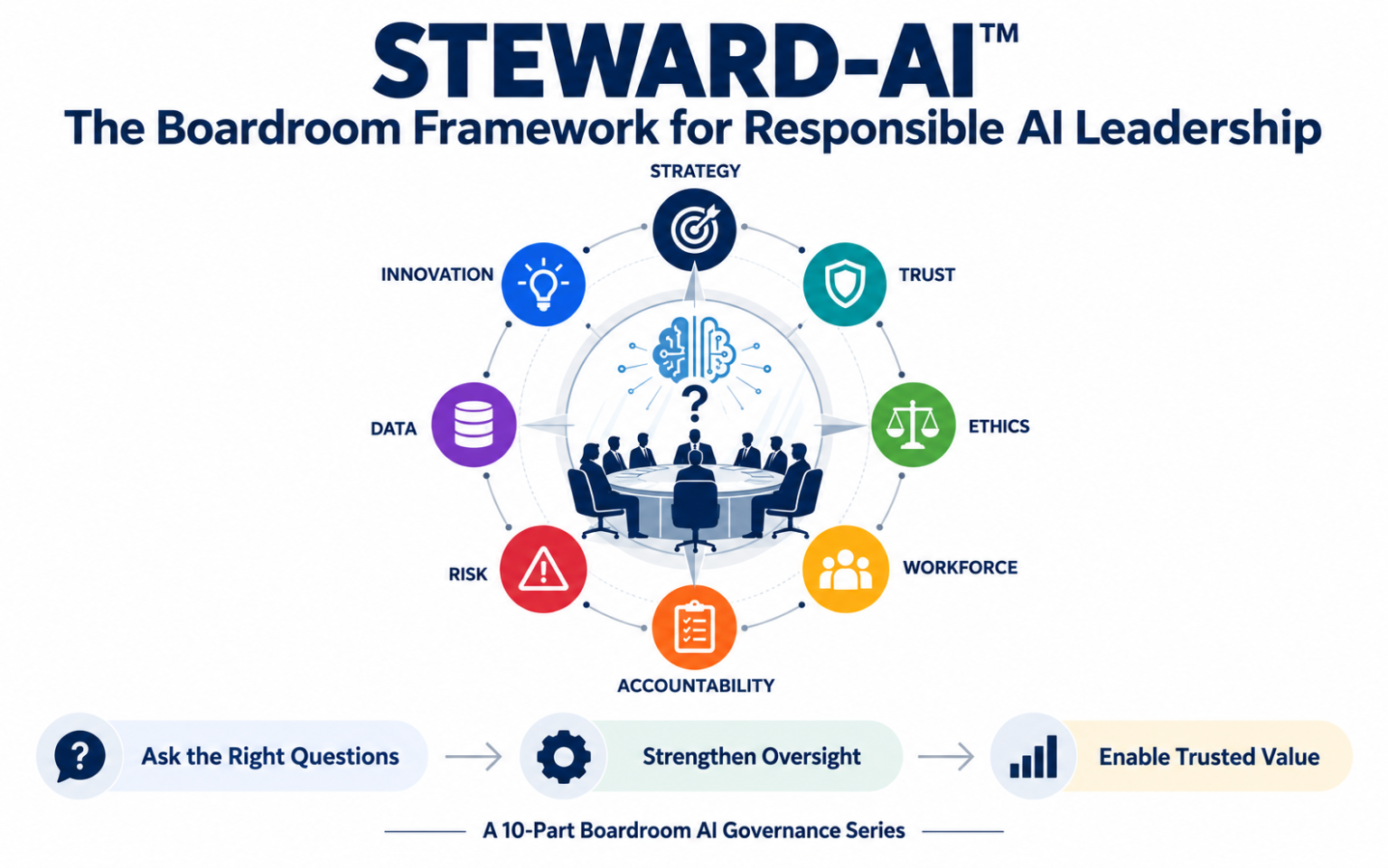
Dr. Rajiv Yadav, drawing on 35 years of boardroom experience across banking, fintech, and infrastructure, has published a structured AI governance framework for boards called STEWARD-AI. The acronym maps eight oversight dimensions: Strategy, Trust, Ethics, Workforce, Accountability, Risk, Data, and Innovation. The framework’s operational logic runs on three verbs, Ask, Assess, Act, and is explicitly designed to give directors a repeatable governance rhythm rather than a one-time policy checklist. No named enterprise deployments are cited, and no adoption figures are provided.
What this means for your business
The board’s AI literacy problem is real, but the gap isn’t primarily technical. Most directors can follow a P&L. What they can’t do yet is interrogate an AI investment the way they’d interrogate an acquisition, asking what assumptions would have to be wrong for this to fail. STEWARD-AI’s value, if it has any, sits exactly there. CEOs whose boards currently receive AI updates as pilot recaps and productivity anecdotes are the ones this addresses most directly. If your board conversation hasn’t yet connected AI spend to risk appetite and succession-level workforce decisions, you’re in the target audience.
The framework’s eight dimensions are sensible individually, but the interesting governance claim is that they have to be assessed together. A strategically attractive AI deployment that introduces data sovereignty risk, say, a vendor model trained on customer data without clean contractual ownership, doesn’t fail just one dimension. It fails four simultaneously. That interconnection is where most current board reporting breaks down, because executives typically present AI updates by function or use case, not by cross-cutting exposure. STEWARD-AI’s structure pushes against that habit, though it offers no mechanism for enforcing it beyond the board’s own discipline.
The skeptical read, worth naming because Dr. Yadav’s advisory practice is built on exactly this kind of framework, is that STEWARD-AI is more taxonomy than governance. Naming eight dimensions and three stages doesn’t tell a board how to weight a tension between innovation speed and data privacy, or what escalation actually looks like when an AI model produces a discriminatory outcome in a credit decision. The frameworks that prove durable in practice are the ones that produce a decision, not just a better question. I’d revise this assessment if a subsequent version ships with materiality thresholds, escalation triggers, or board-level KPIs that translate the eight dimensions into something a director can vote on.
Concept deep-dive: AI governance rhythm
An AI governance rhythm is a scheduled, repeating board-level review of AI strategy and risk, as opposed to an ad hoc briefing triggered only by a crisis or a major investment request. The analogy is quarterly earnings review: not because something always changes, but because the cadence itself forces discipline. Without it, boards engage with AI reactively, which means they’re nearly always late. STEWARD-AI’s core structural contribution is normalizing that rhythm rather than treating governance as a project milestone.
Based on reporting from STEWARD-AI: A Boardroom Framework for Responsible AI Leadership | nasscom, originally published 2026-10-09 05:52:00.