
Share with your CHRO
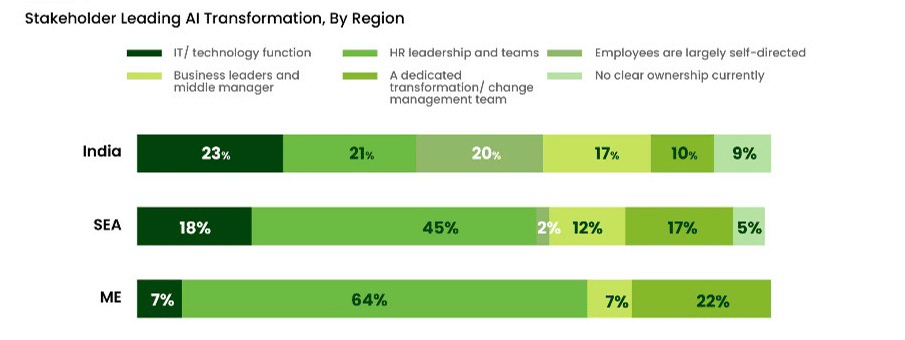
The SHRPA 2026 Global Executive Insights report maps where APAC and Middle East organizations are genuinely stalling on enterprise AI, and the answer isn’t budget or tools. It’s three structural gaps: unclear ownership of transformation, fragmented data infrastructure, and a workforce that isn’t ready. Forty-six percent of HR leaders cite data challenges as their primary blocker. The Middle East shows the tightest ownership clarity, with 64% naming HR leadership as sole driver. India is the most diffuse, with shared ownership spread across functions. SEA sits in between on most dimensions.
What this means for your business
The recurring failure mode in enterprise AI looks like this: a company runs a successful pilot, declares momentum, then watches the initiative dissolve into committee. This report puts numbers to that pattern across three distinct regions. If your organization has global HR operations spanning any of these geographies, the data suggests you can’t import a single transformation playbook. The specific condition that predicts stalling, ownership diffusion, varies sharply by region, which means your India operations and your Gulf operations are probably failing for different reasons even if the symptoms look identical.
The workforce readiness finding is the sharpest result here, and it cuts against the current consensus. HR leaders in the Middle East and SEA are doubling down on the pairing of deep domain expertise with AI fluency for executive roles, which sounds reasonable on the surface. But the report flags that almost none of those same leaders are prioritizing human judgment skills at the executive level. That gap matters because AI systems making decisions inside an enterprise workflow, without someone trained to supply historical organizational context, produce outputs that are technically fluent and contextually wrong. Competency frameworks that treat AI fluency as a substitute for judgment rather than a complement to it are building a quiet fragility into leadership pipelines.
The practical decision this reframes is not whether to run AI training programs but what those programs are optimizing for. Organizations that treat AI fluency as the destination, rather than as infrastructure supporting judgment, will find their executive bench increasingly good at operating tools and increasingly poor at knowing when the tools are wrong. If your current workforce AI readiness initiative doesn’t explicitly measure and develop contextual judgment alongside technical fluency, that’s the budget conversation worth having now, not after the next failed deployment.
Concept deep-dive: Pilot-to-scale gap
The pilot-to-scale gap describes the organizational chasm between a successful limited AI experiment and a deployed capability that runs across the enterprise. A pilot can succeed precisely because it’s isolated, it has a champion, clean data, and a narrow scope. Scaling removes all three conditions simultaneously. The business relevance is that most AI ROI calculations are built on pilot results, which means the numbers used to justify investment are drawn from the conditions least likely to survive deployment.
Based on reporting from SHRPA 2026 Global Executive Insights: Regional View on Scaling AI Transformation, originally published 2026-11-01 22:58:00.