
Share with your CIO
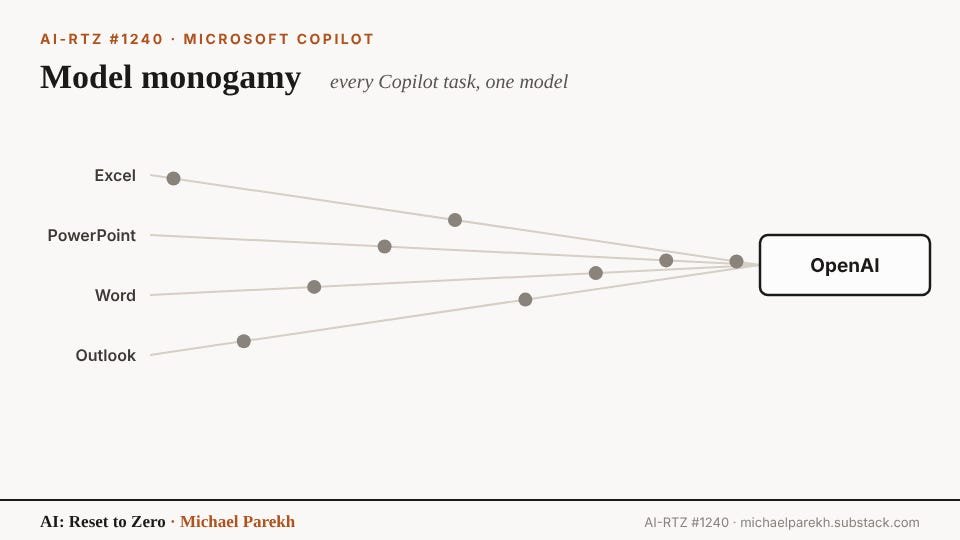
Microsoft has rebuilt Copilot from a single-model product into a multi-model orchestration platform that routes Office tasks across OpenAI, Anthropic, and its own models based on cost and quality. Corporate users have more than doubled this year to over 30 million. Microsoft is on track to pay Anthropic more than $2 billion annually to power Copilot, even as it leans back toward OpenAI when those models are competitive, since Microsoft runs them at no incremental cost. Charles Lamanna, 38, now runs Copilot engineering, Teams, and Office, and is being positioned as a possible Nadella successor.
What this means for your business
The model router changes the enterprise AI procurement dynamic in a concrete way. When your organization buys Copilot, you’re no longer buying OpenAI with a Microsoft wrapper. You’re buying an abstraction layer that picks whichever model Microsoft decides is cheapest and good enough for each task. That’s a meaningful shift in what you’re actually contracting for, and your IT and procurement teams should understand it before renewing seats.
The “Costco of AI” framing is more strategically pointed than it sounds. Costco’s model is low margin, high volume, with membership fees as the profit engine. Microsoft is running the same play: compress model costs through volume and routing, capture margin in the M365 bundle, and make AI access feel like a utility rather than a premium service. The bet is that breadth and distribution beat depth and best-in-class quality. That works until enterprise users who already have Claude or ChatGPT habits decide the convenience isn’t worth the capability tradeoff.
The signal worth watching is adoption quality, not adoption volume. Thirty million corporate users sounds impressive against 450 million Office 365 seats, but National Life Group’s CIO told The Information that most of his employees still use ChatGPT even after Copilot improved. Seat counts and daily active habits are very different metrics. If Microsoft’s next earnings call doesn’t start distinguishing between the two, the 30 million number deserves serious skepticism.
Concept deep-dive: Model routing
A model router is a lightweight system, in Microsoft’s case a homegrown LLM, that intercepts each AI task and selects which underlying model handles it. It exists because different models have different strengths and cost profiles: one may be better at spreadsheet math, another at writing, another at reasoning-intensive tasks. Think of it like a traffic controller that sends each call to the cheapest capable lane. For enterprises, this means the AI quality you experience depends on Microsoft’s routing logic, not just the frontier model you assume is running.
Based on reporting from AI: Microsoft’s Copilot evolving to ‘a Costco of AI’. AI-RTZ #1240, originally published 2026-10-15 01:02:00.