
Share with your CISO
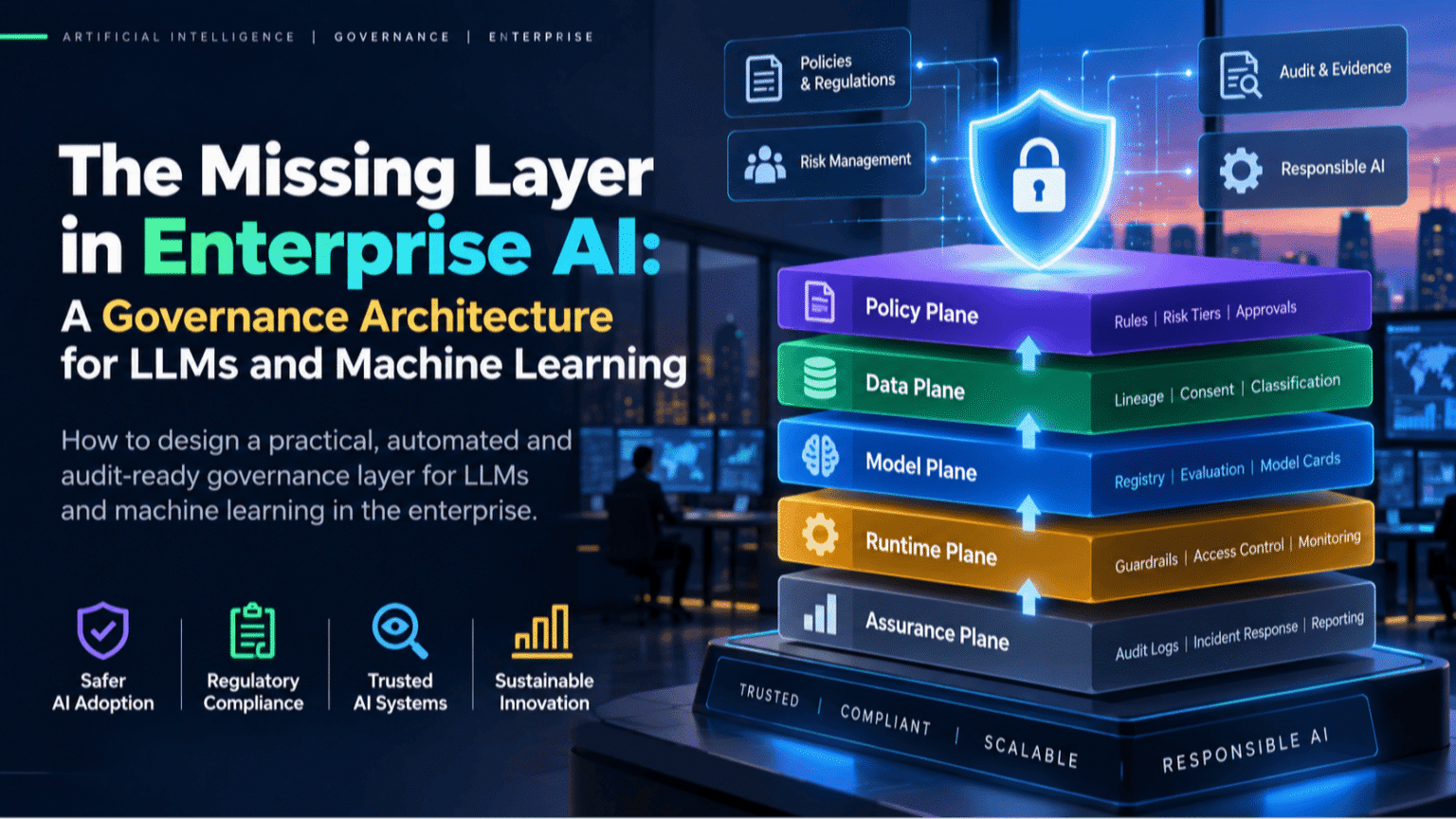
Most enterprises have built three layers of AI infrastructure: a data platform, a model platform, and a growing collection of pilots. What’s missing, as Sunilkumar Reddy Eraganeni argues in this governance architecture breakdown, is the fourth layer that decides which of those pilots should ever touch a customer. The piece proposes a five-plane structure covering policy, data lineage, model registry, runtime controls, and continuous assurance, all connected by an immutable audit trail that makes governance provable rather than merely declared.
What this means for your business
The failure pattern here is recognizable enough to have a name: slide-deck approval. A team demos a promising AI feature, gets a nod in a meeting, ships it in six weeks, and nobody records what model version produced which output or where the input data went. That works fine until a compliance question arrives, at which point the answer takes weeks instead of minutes. Whether this describes your organization depends less on how mature your AI program is and more on whether your logging infrastructure was designed before or after your first production deployment.
The architectural argument is sound, and the honest admission about its limits is what makes it credible. Guardrails on LLM inputs and outputs are probabilistic, not deterministic. Prompt injection and data leakage, catalogued in the OWASP top risks for LLM applications, remain unsolved problems regardless of how good your filters are. What a governance layer actually buys you is containment and traceability, not prevention. That’s a more defensible promise and a more useful one when you’re explaining your posture to regulators under the EU AI Act or responding to a SR 11-7 model risk examination. The CISO who treats this as a security architecture decision rather than a compliance checkbox will build something that survives the first incident.
The practical sequence matters more than the framework’s elegance. Starting with an inventory of every deployed model and LLM-powered feature, including the ones embedded in vendor products and sprawling in spreadsheets, is unglamorous but decisive. You can’t tier risk you haven’t listed. The governance programs that collapse aren’t the ones with weak frameworks; they’re the ones that launched tooling before they knew what they were governing. If your organization still can’t answer “which model version produced that customer-facing output last Tuesday,” the architecture conversation is premature and the inventory conversation is overdue.
Based on reporting from The Missing Layer in Enterprise AI: A Governance Architecture for LLMs and Machine Learning, originally published 2026-10-23 03:31:00.