
Share with your CISO
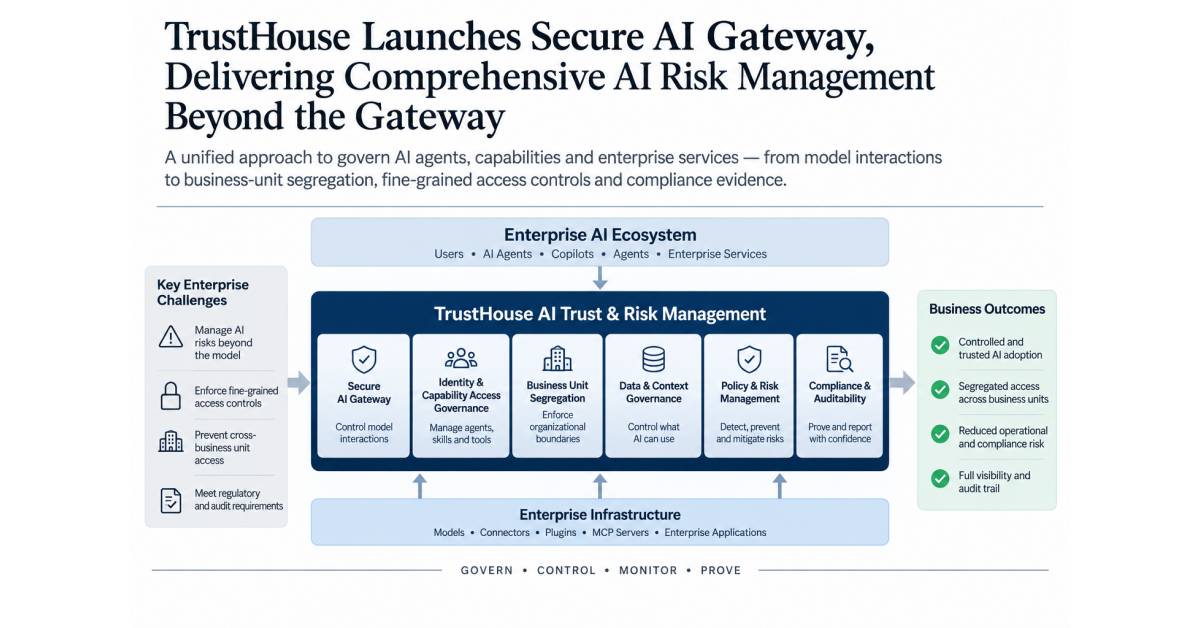
TrustHouse is betting that the enterprise AI security perimeter has already moved, and that most organizations haven’t caught up. The company’s Secure AI Gateway positions itself not as a replacement for existing AI model gateways but as a governance layer that wraps around agent identities, tool access, business-unit boundaries, and audit trails. The core argument is that controlling what model an agent talks to is a solved problem, while controlling what that agent can do inside enterprise systems is not.
What this means for your business
If your organization has deployed AI agents that connect to internal databases, HR platforms, or financial systems, you already have a governance gap whether or not you’ve named it. The traditional AI gateway handles the conversation between a user and a model. TrustHouse is targeting the next layer, the question of whether a finance agent should be able to call the same enterprise connectors and MCP servers (lightweight integration points that expose business tools to AI agents) as an HR agent running on the same shared infrastructure. If you’re still mapping your AI risk posture to model access alone, this story is about you.
The architectural claim TrustHouse is making holds up under scrutiny. Shared AI infrastructure does not equal shared business permissions, and that gap is where real exposure lives. A single misconfigured agent capability can give a sales automation tool read access to payroll records if nobody has drawn an explicit boundary. The recurring failure mode looks like this: enterprises assume their existing identity and access management controls extend naturally to AI agents, then discover that agents inherit ambient permissions from the services they touch rather than the policies their human owners intended. TrustHouse is selling into that gap, which means the pitch has a natural incentive to emphasize how wide the gap is, but the underlying problem is structural and not invented.
The vendor that wins the AI governance layer is likely the one that integrates cleanly with existing identity providers rather than the one that demands a rip-and-replace. TrustHouse explicitly positions its approach as complementary to current infrastructure, which is the right posture for enterprise sales but also the hardest thing to execute. If your current AI security review still treats agent governance as a roadmap item rather than a present-tense control, the right question isn’t whether to buy TrustHouse specifically. It’s whether your next vendor renewal conversation includes a concrete answer to what governs agent-to-service access today.
Concept deep-dive: AI Agent Identity
An AI agent identity is a persistent, policy-bound credential assigned to an autonomous AI system, distinct from the human user who deployed it, much like a service account for a software process but with the added complexity that agents make contextual decisions about which tools to invoke. It exists because agents can act across dozens of enterprise systems in a single workflow, and attributing those actions to a human login obscures accountability. Without it, audit trails collapse and permission boundaries become unenforceable.
Based on reporting from TrustHouse Launches Secure AI Gateway, Extending Enterprise AI Risk Management Beyond Model Gateways, originally published 2026-11-20 11:07:00.