

Share with your CTO
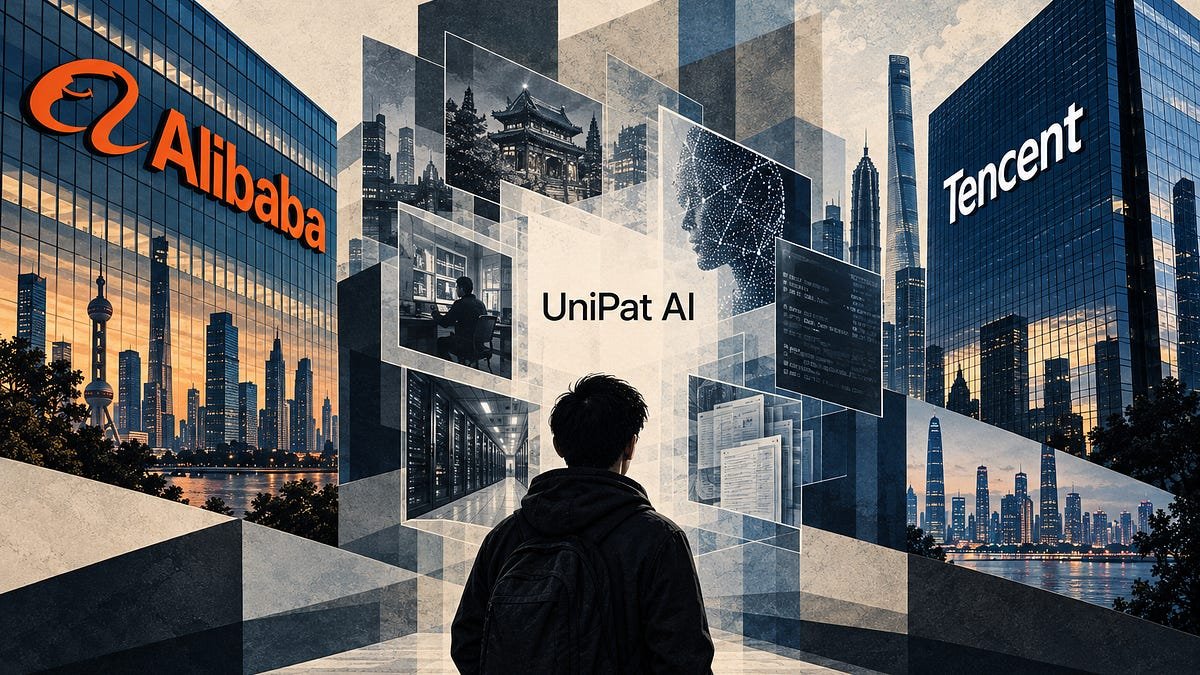
Alibaba is leading a $300 million investment in UniPat, an AI benchmarking and training platform founded in late 2025 by a former Alibaba Tongyi division intern, at a $2.5 billion valuation. UniPat hosts performance evaluations for coding agents, browser agents, and multimodal models, while also supplying human-generated internet data that model trainers are scrambling to source. Tencent and HongShan Group are reportedly co-investing. The deal mirrors Western infrastructure plays, specifically Stripe’s $7.5 billion OpenRouter acquisition and Nvidia’s $12.9 billion Hugging Face purchase, signaling that the platform layer sitting between raw compute and finished AI products is where valuation gravity is now concentrated.
What this means for your business
The thing to notice here is not the founder story but the asset class. Alibaba isn’t buying compute or a model. It’s buying the measurement and data supply layer, the infrastructure that tells you whether a model is actually improving and feeds the training pipeline with scarce human-generated content. Any enterprise CTO currently relying on public benchmarks to evaluate AI vendors is depending on infrastructure that the vendors themselves are now racing to own. That changes how much you should trust those benchmarks.
Alibaba’s angle is straightforward. Its Qwen model family competes globally, and controlling a respected benchmarking platform creates a distribution advantage that looks neutral but isn’t. When the company running the scoreboard also fields a team in the competition, the scoreboard’s independence deserves scrutiny. This doesn’t mean UniPat’s evaluations will be corrupted, but enterprise buyers sourcing models through Alibaba Cloud should weight third-party benchmark results more heavily than platform-native ones, and start tracking which benchmarking providers remain genuinely independent.
The deeper pattern here is vertical consolidation of the AI supply chain from a direction most Western observers aren’t watching. The same week DeepSeek released a 552-billion-parameter model and Chinese chipmakers raised prices on Huawei Ascend accelerators, Alibaba locked down evaluation infrastructure. A CTO who assumed the Asian AI stack was fragmented and dependent on Western tooling should revise that assumption now. The question to carry into your next vendor review is whether your AI evaluation process is insulated from the commercial interests of the parties being evaluated, or whether you’ve quietly outsourced that judgment to someone with skin in the game.
Concept deep-dive: AI Benchmarking Platforms
A benchmarking platform runs standardized tests across AI models to measure their performance on defined tasks, think of it as a Consumer Reports for AI capabilities. The business value is objectivity: buyers need a source of truth that isn’t the vendor’s own marketing. These platforms become powerful when widely adopted because model developers optimize for their tests, making the benchmark setter a de facto standard-setter. Owning one gives a strategic investor influence over which capabilities the broader market prioritizes and rewards.
Based on reporting from Alibaba eyes former intern’s AI infrastructure company in $300 million deal, originally published 2026-09-10 22:30:00.