

Share with your CIO
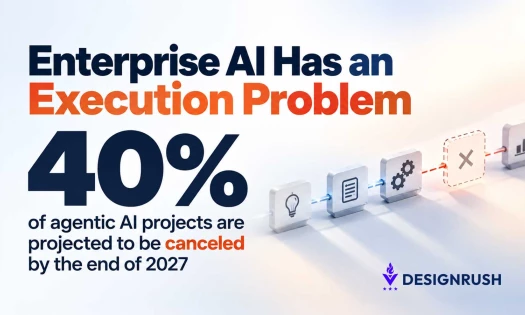
Mark Zuckerberg told Meta employees in July that AI agent deployment has moved slower than expected, a rare concession from a company that committed up to $145 billion in 2026 infrastructure spend on agents being ready. Alongside the timeline slip, a 10% workforce reduction and 7,000 employees reassigned into AI roles hadn’t produced the expected benefits. Gartner puts the broader failure rate in sharp relief: only 10% of organizations have agentic AI in production, and more than 40% of agentic projects are projected to be canceled by end of 2027.
What this means for your business
The companies most exposed here aren’t the ones that haven’t started agent projects. They’re the ones that launched pilots, hit a wall, and are waiting for the model or the vendor to get better before trying again. Meta’s situation makes the waiting strategy harder to defend. If a company with unlimited compute, world-class research talent, and full control over its own org chart is still 90 days away from seeing benefits, the constraint isn’t technical. It’s structural, and no model release fixes a structural problem.
The recurring failure mode looks like this: a team identifies a promising workflow, drops an agent into it, and discovers that the workflow was never clean enough to automate in the first place. Approval chains are informal. Exceptions are handled by institutional memory. Handoffs between systems depend on someone knowing which system to call. The agent exposes all of it at once. The fix isn’t a better prompt or a newer model; it’s redesigning the workflow before the agent touches it, which is organizational work that most AI roadmaps don’t budget for and most keynotes don’t describe. Gartner’s 40% cancellation projection reflects exactly this gap closing in the wrong direction.
The Cheesecake Labs CEO framing this as an organizational design problem is correct, even accounting for the fact that his firm sells AI delivery services and has an obvious incentive to position the hard part as consulting work rather than tooling. The data backs the argument independent of who’s making it. The CIOs most likely to get out ahead of this aren’t the ones adding governance slides to their agent decks; they’re the ones who have already mapped which specific workflows they’re redesigning, who owns the transition, and what a production-ready definition looks like before the pilot starts. I’d revise this view only if a meaningful cohort of agent deployments succeeded without that pre-work, and so far none of the public evidence points that direction.
Based on reporting from Why Enterprise AI Agents Stall in Production, originally published 2026-10-02 04:03:00.