
Share with your CTO
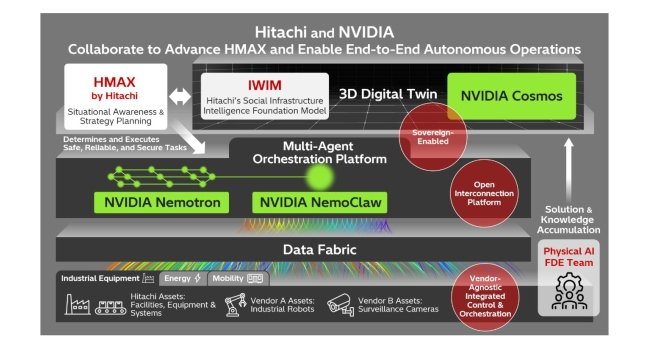
Hitachi is betting that the missing layer in industrial AI isn’t better models, it’s coordinated control across everything already on the factory floor. Through a deepened partnership with NVIDIA on autonomous industrial operations, Hitachi is building a Multi-Agent Orchestration Platform that connects its IWIM infrastructure intelligence model to NVIDIA’s Cosmos world foundation models and NemoClaw agent framework. The goal is end-to-end autonomous control across heterogeneous equipment, including legacy gear and third-party robots, while keeping proprietary operational data sovereign inside the customer’s own environment. A dedicated Physical AI FDE team, drawing on GlobalLogic’s engineering depth, will deploy on-site to make it real.
What this means for your business
The companies most exposed to this announcement are the ones currently running multi-vendor shop floors where no single AI system has visibility across the whole operation. If your industrial AI strategy today is a collection of point solutions, each talking only to the equipment it was sold with, this collaboration is a direct architectural challenge to that posture. The question isn’t whether Hitachi delivers, it’s whether your current vendor stack even has a plan for cross-vendor agent orchestration at the OT layer.
The sovereignty angle is the sharpest part of this announcement and the most underreported. NVIDIA’s OpenShell secure runtime and the closed IWIM reasoning layer are designed to let customers run frontier AI agents without exposing process data, control logic, or operational know-how to external model providers. That matters enormously in energy, utilities, and defense-adjacent manufacturing, where the data generated on the factory floor is itself a competitive asset. Hitachi is essentially arguing that open interconnection and data sovereignty aren’t in tension, and that architecture, not policy, is how you resolve the conflict.
The validation pathway through digital twins is the credibility test to watch. Connecting IWIM to Cosmos so that agent behavior gets stress-tested inside a simulation before it touches real equipment is the right engineering instinct, but industrial digital twins are notoriously hard to keep calibrated against physical reality. If Hitachi’s FDE teams can demonstrate that the simulation-to-deployment gap closes reliably across diverse equipment types, that’s the proof point that shifts this from a compelling architecture slide to a procurement conversation. I’d revise the bullish read if early ecosystem partners report the twin validation adding months rather than weeks to deployment cycles.
Concept deep-dive: Multi-agent orchestration in OT environments
Multi-agent orchestration, think of it as an air traffic control system for AI, coordinates multiple specialized AI agents that each control one piece of equipment or one process, so they act toward a shared outcome rather than optimizing independently. In IT systems this is hard. In OT environments, operational technology like SCADA systems and industrial controllers built before modern networking, it’s genuinely difficult because the agents must respect physical safety constraints that can’t be overridden by a software retry. That’s the gap this platform is designed to close.
Based on reporting from Hitachi and NVIDIA collaborate to advance HMAX and enable end-to-end autonomous operations through the integrated control of physical AI, originally published 2026-07-17 10:35:00.