
Share with your CDO
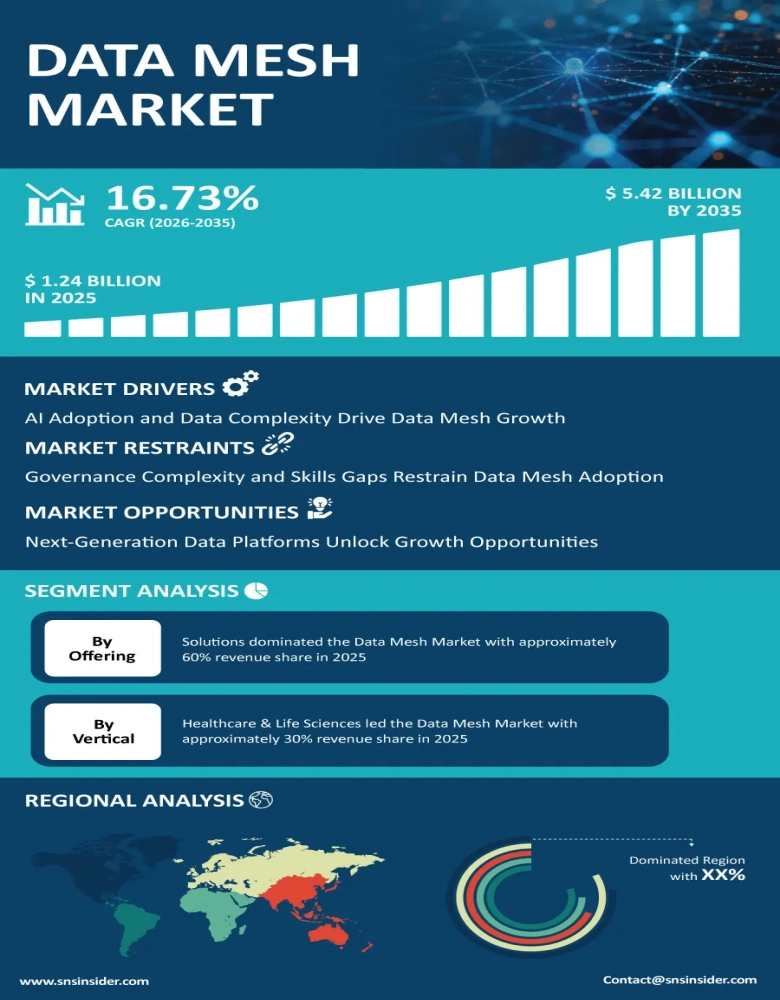
The data mesh market is forecast to grow from $1.24 billion in 2025 to $5.42 billion by 2035, a 16.73% compound annual growth rate, according to SNS Insider. The story is driven by enterprises replacing centralized data warehouses with domain-owned data products that let individual business units control and publish their own data. Healthcare and life sciences claimed roughly 30% of 2025 revenue, cloud deployment leads on share, and Asia Pacific is projected to outpace every other region in growth rate through the decade.
What this means for your business
The CDOs most exposed here are the ones still running a centralized data team as the single pipeline for every analytics request. That model worked when data consumers were few and patient. It breaks under the weight of enterprise AI, where every product team, every clinical unit, every regional sales org needs governed, trustworthy data on its own cadence. The 16.73% growth rate reflects not hype but organizational pain: the centralized bottleneck is now visibly costing AI timelines.
The vendor list in this forecast, which spans Databricks, Snowflake, Microsoft Azure, AWS, and Collibra alongside a dozen specialists, signals that data mesh is no longer a greenfield architecture choice. It’s becoming table stakes infrastructure. The interesting competitive pressure isn’t between vendors; it’s between the CDO who has already restructured around domain ownership and the one still negotiating internal politics about who controls the data catalog. The former will have cleaner AI training pipelines, faster regulatory compliance responses, and shorter time-to-insight for business units. The latter will keep apologizing for data readiness delays.
The healthcare dominance in this market is worth sitting with. Interoperability mandates, HIPAA compliance requirements, and the push toward AI-assisted clinical decision-making are forcing health systems to solve federated governance, meaning governance that works across independently owned data domains without a single controlling authority, faster than most other verticals. If healthcare is leading adoption despite its legendary IT conservatism, the governance problem data mesh solves is more urgent and more general than skeptics have assumed. The CDO who treats this as a future-state aspiration rather than a current procurement decision is already behind the curve.
Concept deep-dive: Data Mesh
Data mesh is an architectural approach where each business domain, think “the marketing team’s customer data” or “the clinical team’s patient records,” owns, maintains, and publishes its data as a product for other teams to consume. The analogy is microservices in software engineering: instead of one monolithic app, you have many independently deployable services. Data mesh applies that logic to data pipelines. The business case is that ownership accountability improves data quality, and decentralization reduces the central team bottleneck that slows AI and analytics projects.
Based on reporting from Data Mesh Market Size To Exceed $5.42 Billion By 2035, originally published 2026-07-23 02:05:00.