
Share with your CTO
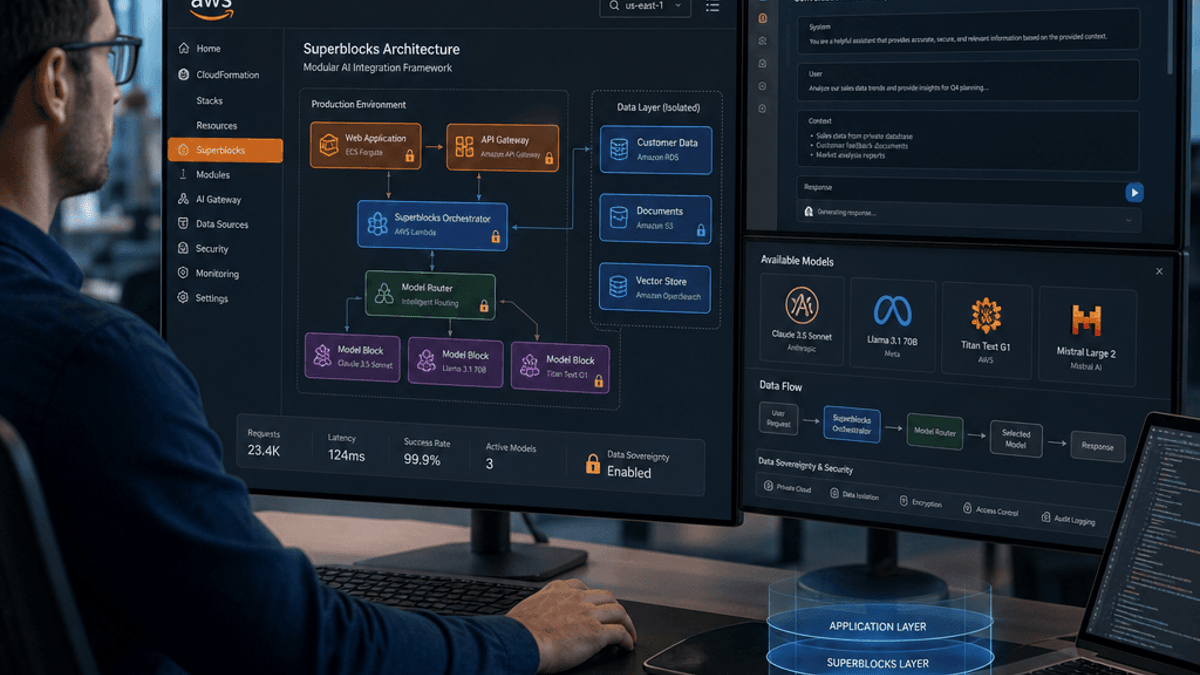
AWS is embedding Superblocks, a two-year-old AI development platform, directly into customers’ private cloud environments rather than offering it as an external hosted service. The move is a deliberate architectural statement: enterprises get conversational, AI-driven application building (describe what you want, the platform generates the code and integrations) without routing sensitive data through third-party infrastructure. Superblocks runs model-agnostic, supporting OpenAI, Anthropic, Google, or customer-hosted open-source models. This AWS-Superblocks private cloud partnership reflects a broader hyperscaler play to win regulated enterprise workloads by meeting compliance teams on their own terms.
What this means for your business
The regulated-industry stalemate over AI coding tools is real and breaking in a specific direction. Security and compliance teams at financial services and healthcare firms have been blocking adoption of tools like Superblocks not because the productivity case is weak, but because the data residency case was absent. Private cloud deployment removes that objection structurally. If your engineering org has a backlog of internal tooling, admin panels, and workflow automation that keeps getting deprioritized, the friction point just shifted from legal to procurement.
The deeper claim worth pressure-testing is whether model-agnosticism actually holds up at scale inside a private deployment. “Works with any model” is easy to advertise when you’re running on someone else’s cloud and routing API calls. Running model-agnostic orchestration inside a customer’s VPC, where network controls, IAM policies, and data classification rules all vary, is genuinely harder. The architecture the article describes, where application logic, model selection, and deployment environment are fully separable layers, is theoretically clean but operationally brittle until a vendor has proven it across dozens of enterprise configurations. Superblocks is two years old. The legitimacy AWS lends is real, but it’s not the same as a production track record across 200 enterprise tenants.
The comparison worth watching is how this plays against Microsoft’s GitHub Copilot and Azure OpenAI deployments. Microsoft has the enterprise distribution, the developer mindshare, and the compliance certifications already embedded in existing procurement relationships. AWS winning AI dev tooling workloads requires convincing CTOs to treat their cloud as the primary development platform, not just infrastructure. I’d revise the bullish read on this partnership if Superblocks can’t name a handful of regulated-industry deployments within 12 months: distribution from AWS is an on-ramp, not a customer base.
Concept deep-dive: Composable AI architecture
Composable AI architecture means the application, the AI model powering it, and the infrastructure running it are built as independent, swappable layers rather than one bundled product. Think of it like separating your car’s engine, chassis, and fuel type so you can swap each without replacing the whole vehicle. The business driver is model obsolescence: enterprises don’t want to rebuild internal tools every 18 months because the AI layer they chose got outcompeted. Modularity converts a recurring switching cost into a configuration decision.
Based on reporting from AWS Embeds Superblocks in Private Clouds, Reshaping AI Dev, originally published 2026-08-03 16:17:00.