
Share with your CTO
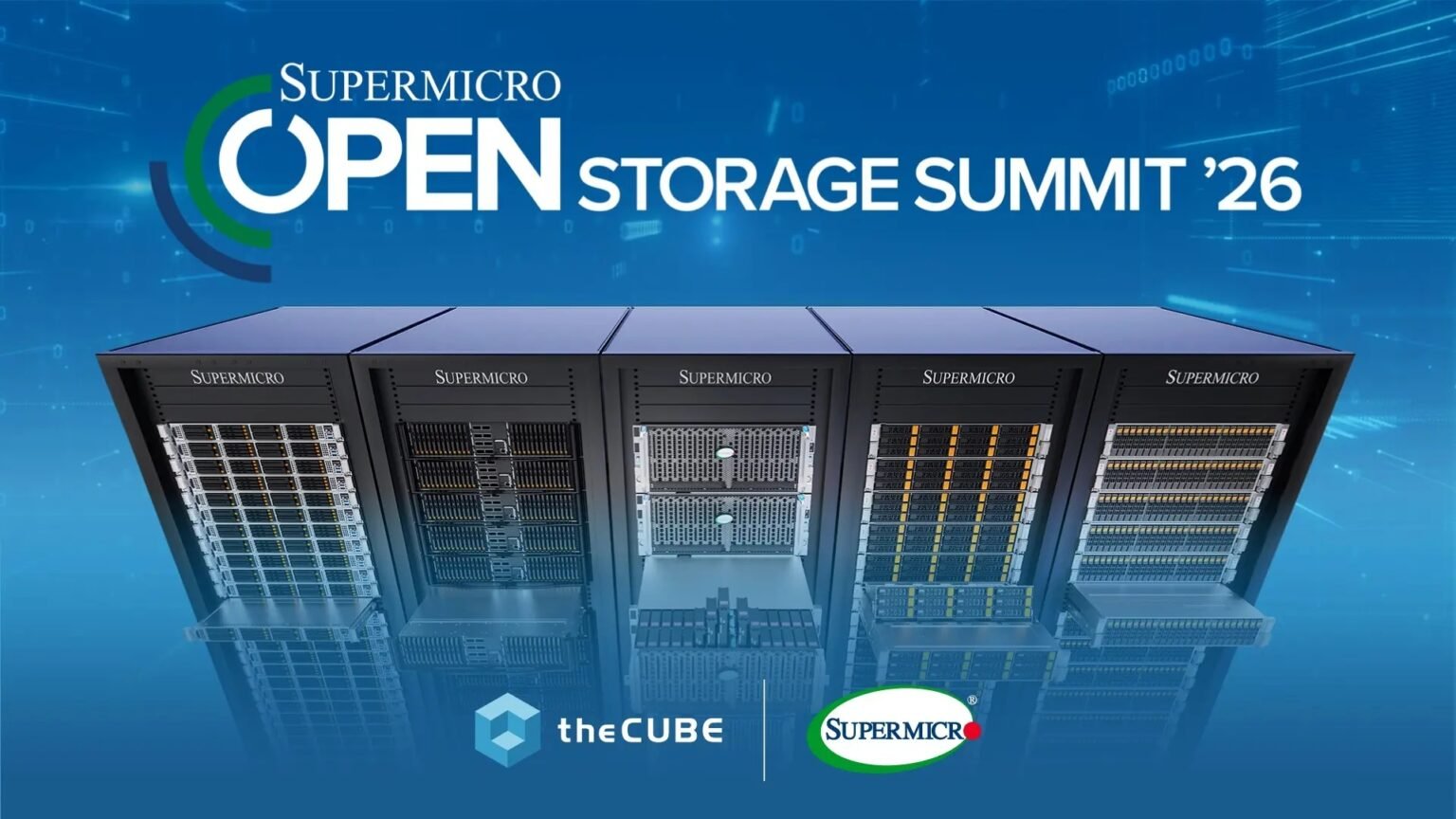
Supermicro is making a structural argument: that agentic AI, the shift from single-turn chatbots to autonomous systems that plan and execute multi-step tasks, has created a new storage tier that most enterprise infrastructure wasn’t designed to serve. The company entered fiscal Q4 with over $60 billion in new orders, and its Open Storage Summit video series, running August 11 through September 3, is where it will publicly work through the infrastructure architecture required to support that demand, spanning KV cache storage nodes, CPU-GPU orchestration, and persistent agent memory platforms.
What this means for your business
The signal worth extracting from what is partly a promotional piece, produced by a paid media partner of the summit, is that KV cache storage is now a named infrastructure category with dedicated hardware. Nvidia’s BlueField-4 STX introduced the CMX context memory platform at GTC in March, and Supermicro, Vast Data, and Nutanix announced products built on it within the same news cycle. If your AI inference stack is still treating storage as a passive data warehouse rather than an active component of the reasoning loop, you’re already a product generation behind.
The CPU angle deserves more attention than it typically gets. Agentic workloads don’t just increase GPU demand; they distribute reasoning work across sub-agents that run on CPUs, which is why Supermicro’s new H15 server portfolio, built on AMD’s sixth-generation EPYC 9006 processors, is designed to pair with GPU accelerators rather than replace them. The architecture bet here is that inference pipelines for agents look fundamentally different from training pipelines, with CPUs handling orchestration and state management while GPUs handle the heavy model math.
MinIO’s AIStor Memory product points to an organizational risk that most infrastructure teams haven’t priced in: agent-generated knowledge, the decisions, workspaces, and intermediate outputs produced during a long-running task, is currently ephemeral in most deployments. If agents are doing meaningful work across lines of business, that knowledge has compounding value, and losing it between sessions is a real capability cost, not just a storage preference. The vendor building persistent agent memory infrastructure now will set the default data contract before procurement teams formalize the category.
Concept deep-dive: KV cache
A KV cache, short for key-value cache, is the working memory an AI model uses mid-conversation: it stores the mathematical representations of everything said so far so the model doesn’t recompute context from scratch on every response. Think of it as a scratch pad that grows with every exchange. For agentic systems running multi-hour tasks, that scratch pad becomes enormous and latency-sensitive, which is why it now warrants dedicated storage hardware rather than living on GPU memory alone.
Based on reporting from Storage architecture focus at Supermicro Summit, originally published 2026-08-05 17:19:00.