
Share with your CISO
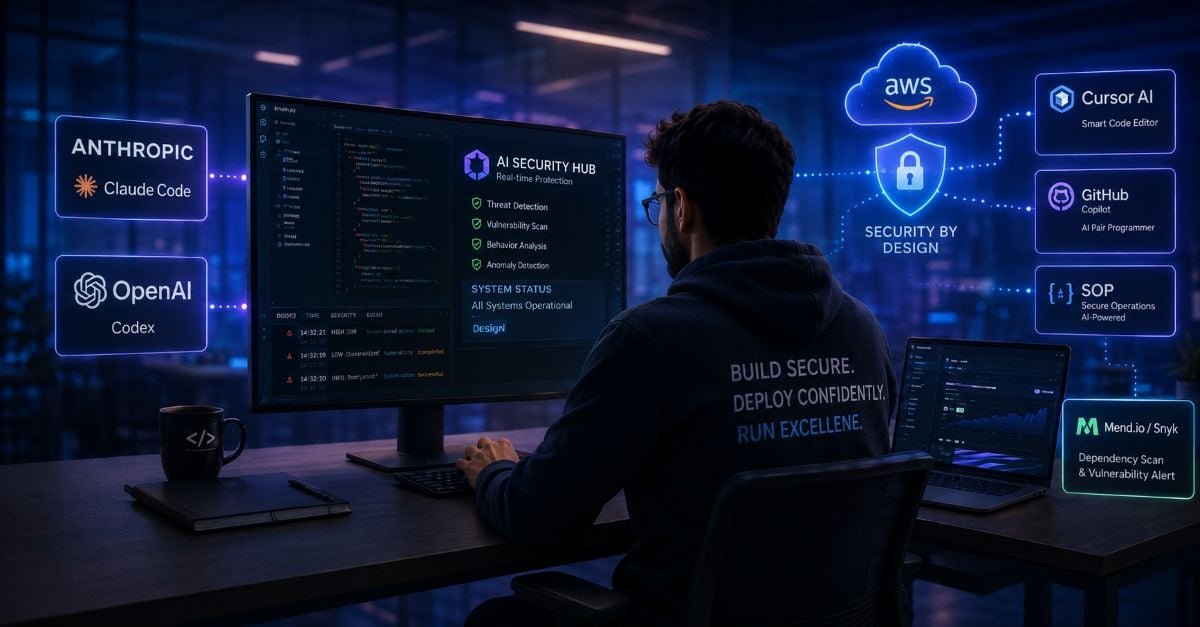
AWS is positioning itself as the security layer between AI coding tools and production code, announcing integrations with both Anthropic and OpenAI that route their coding assistants through AWS Continuum, its AI-powered vulnerability discovery and remediation service. Alongside that, AWS expanded Security Hub Extended to ingest threat data from Chainguard and Socket, and is embedding Miggo Security rule sets directly into the AWS WAF console. The timing isn’t incidental: 40% of surveyed organizations say AI already generates the majority of production code merged in the last 90 days, and 75% have confirmed at least one production incident attributable to AI-generated code.
What this means for your business
The attack surface your team is defending just changed shape. When AI tools generate the majority of production code, the traditional assumption that a human developer reviewed every line before merge no longer holds. A vulnerability isn’t introduced by a distracted engineer anymore. It’s introduced at machine speed, at machine volume. AWS is betting that the right response is to embed security controls inside the same agentic workflow that creates the risk, not bolt them on afterward.
The integrations with Anthropic and OpenAI matter less as partnership announcements and more as a platform signal. AWS isn’t trying to compete with Claude or ChatGPT on code quality. It’s inserting Continuum as mandatory infrastructure between those tools and your deployment pipeline, making AWS the security clearinghouse for AI-generated code regardless of which model writes it. That’s a durable position if it holds: model preferences will shift, but compliance requirements don’t.
The Chainguard and Socket additions to Security Hub Extended are the less-celebrated move worth watching. Open source dependency poisoning, where malicious packages infiltrate the software supply chain before a developer knowingly imports them, is the attack vector most likely to scale alongside AI-accelerated development. The question worth holding: can AWS ingest threat intelligence from these partners fast enough to outrun the malicious package publication rate, or does the integration create a false confidence that your pipeline is cleaner than it is?
Concept deep-dive: Agentic workflow security
An agentic workflow is a chain of AI agents that hand off tasks autonomously, each one taking output from the last and producing input for the next, without a human in the loop at every step. The security problem is that each agent in the chain may operate with different permissions and different trust levels, and those identities shift dynamically. Think of it like a temporary staffing agency where every worker has a different badge level and the badges change mid-shift. AWS Continuum is designed to apply the right security policy to the right agent at the right moment in that chain, which is meaningfully harder than securing a static application.
Based on reporting from AWS Extends DevSecOps Reach to AI Coding Tools from Anthropic and OpenAI, originally published 2026-08-06 11:53:00.