
Share with your CTO
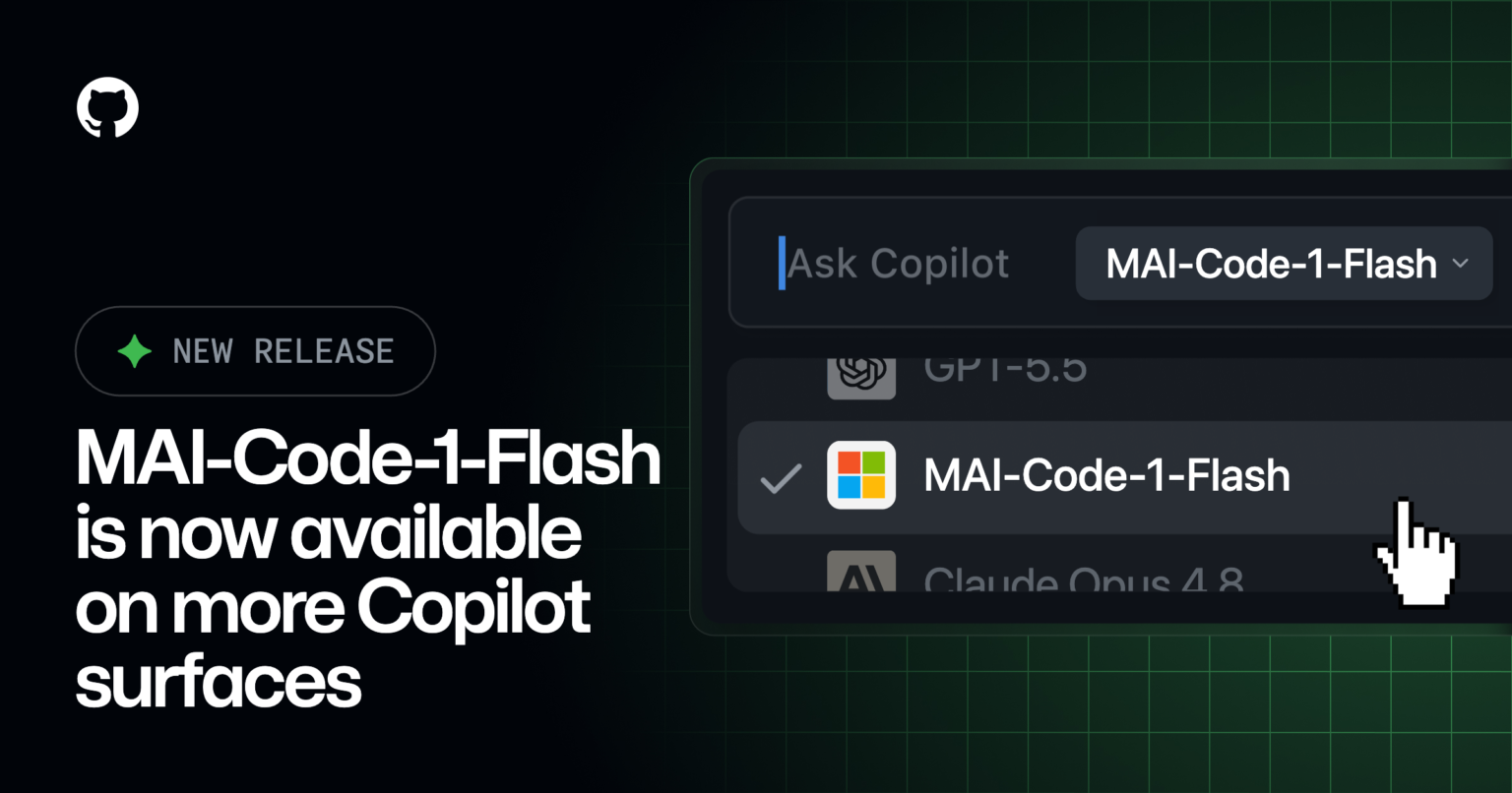
Microsoft is pushing MAI-Code-1-Flash, its purpose-built small coding model, across nine GitHub Copilot surfaces simultaneously, including Copilot CLI, JetBrains IDEs, Visual Studio, Xcode, Eclipse, and the Copilot cloud agent. The model is available now on Free, Student, Pro, Pro+, and Max plans, with Business and Enterprise access coming soon. Microsoft claims it outperforms other small models in early testing on coding quality for its size class.
What this means for your business
The surface area expansion here is the signal, not the model itself. When a coding assistant reaches the CLI, the mobile app, the cloud agent, and six IDEs in a single changelog entry, Microsoft is standardizing on a baseline inference layer across every touchpoint a developer touches in a day. Your engineering org doesn’t adopt a model, it adopts an ambient presence.
Small, task-specific models like MAI-Code-1-Flash exist because large general-purpose models are expensive to run at developer-scale latency. A model purpose-built for code completion can deliver faster responses at lower compute cost without sacrificing quality on the narrow task it was designed for. The business consequence is that Microsoft can price Copilot aggressively on lower-tier plans while still improving output quality, which raises the floor on what “free tier” developer tooling looks like and makes it harder for point-solution competitors to justify premium pricing.
Enterprise access is still pending, which means your developers on Business or Enterprise plans will watch their colleagues on personal Pro accounts get the new model first. That sequencing isn’t accidental. It builds pull demand inside your org before you’ve made a procurement decision. The question worth holding: how many of your engineers will start routing work through personal accounts before your enterprise rollout arrives?
Concept deep-dive: Purpose-built small models
A purpose-built small model is trained and fine-tuned on a narrow domain rather than broad general knowledge. It exists because general-purpose large models carry enormous parameter counts that increase latency and cost per token. Think of it as a specialist versus a generalist physician: the specialist is faster and cheaper for the specific condition, even if the generalist knows more overall. For coding assistants running inline suggestions across millions of keystrokes daily, that cost and speed differential compounds fast into real infrastructure savings.
Based on reporting from MAI-Code-1-Flash available on more Copilot surfaces, originally published 2026-06-18 03:00:00.