
Share with your CTO
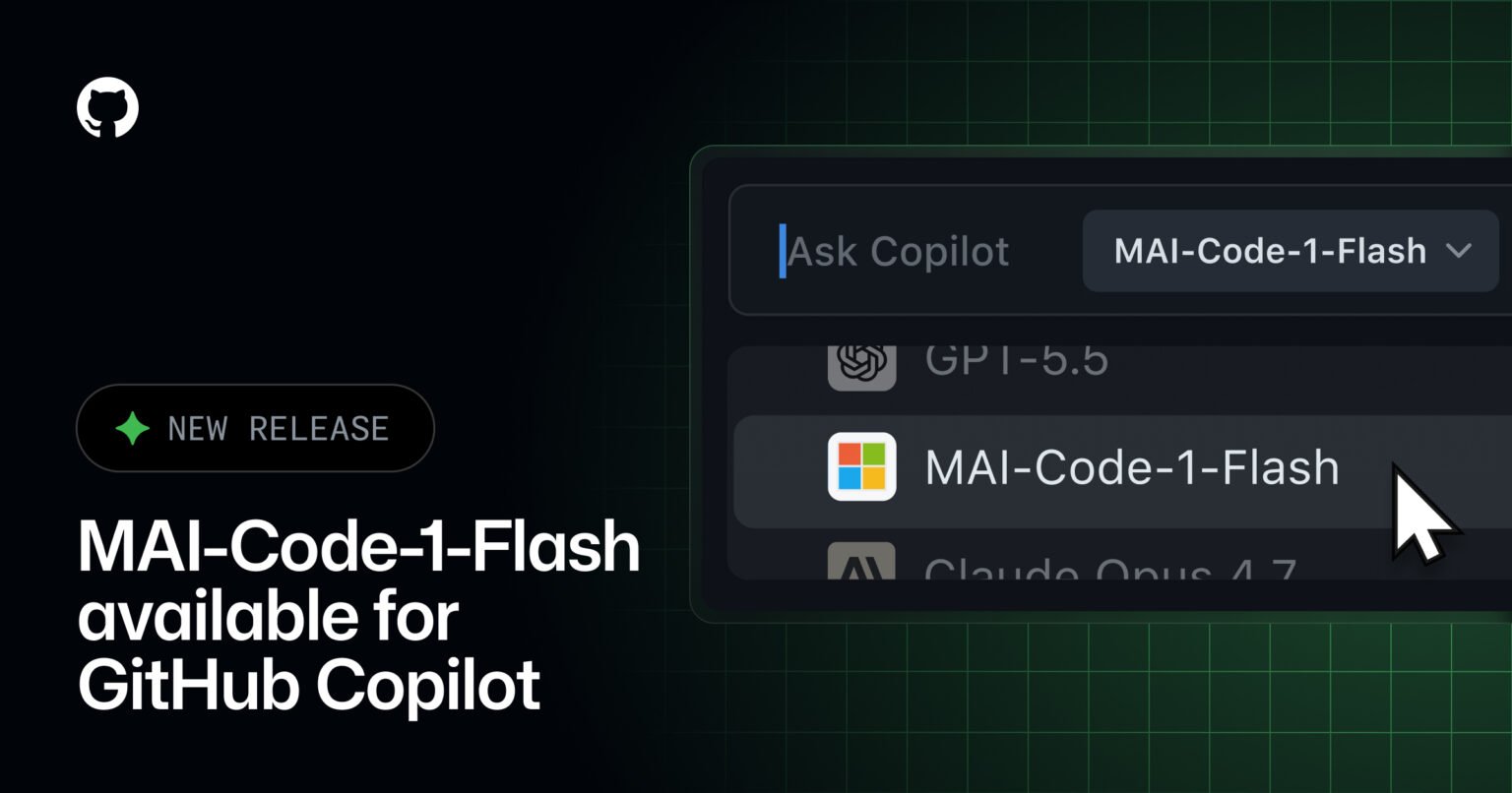
Microsoft is building its own coding model stack inside GitHub Copilot rather than routing everything through third-party providers. MAI-Code-1-Flash, the first in what Microsoft explicitly calls “a new wave of purpose-built coding models,” is now rolling out across Copilot Free, Student, Pro, Pro+, and Max plans starting in VS Code. The model is positioned as a small-tier option that outperforms comparable small models, designed specifically for lightweight coding workflows rather than heavy reasoning tasks.
What this means for your business
Microsoft is vertically integrating its AI supply chain. Copilot launched as a wrapper around OpenAI models, but MAI-Code-1-Flash signals that Microsoft intends to control the model layer for at least the cost-sensitive, high-volume portion of developer workloads. For any enterprise with thousands of Copilot seats, that shift matters: Microsoft now has direct control over quality, latency, and pricing for the model tier most developers hit most often.
Small models purpose-built for a specific task consistently beat general-purpose models of the same size on that task. This is the coding equivalent of what Google did with Gemini Flash: accept a capability ceiling in exchange for speed and cost efficiency on routine completions. The strategic play is to reserve expensive frontier model calls for complex reasoning while routing inline completions, autocomplete, and simple edits through a cheap, fast, proprietary model. That routing decision is now Microsoft’s to make unilaterally, not yours.
The signal worth watching is how aggressively Microsoft expands this model family. One “Flash” model is an experiment. Three or four, covering different task types and complexity tiers, is a full vertical stack. If Microsoft gets there, enterprises negotiating Copilot Enterprise renewals in 2027 will have far less leverage than they do today, because the model diversity that currently justifies shopping around will have collapsed into a single vendor’s proprietary lineup. The tradeoff is real: tighter integration and likely better performance on coding tasks, in exchange for reduced optionality on the model layer.
Concept deep-dive: Small-tier coding models
A small-tier model is a language model with significantly fewer parameters than frontier models like GPT-4o or Claude Sonnet, trained or fine-tuned on a narrow task domain. They exist because most developer interactions with an AI coding assistant are repetitive and low-complexity: finishing a line, generating a unit test, suggesting a variable name. A useful analogy is a surgical instrument set: you don’t use a scalpel designed for open-heart surgery to remove a splinter. For enterprises, small models mean lower inference costs and faster response times on the interactions that happen hundreds of times per developer per day.
Based on reporting from MAI-Code-1-Flash is now available for GitHub Copilot, originally published 2026-06-02 03:00:00.