
Share with your CFO
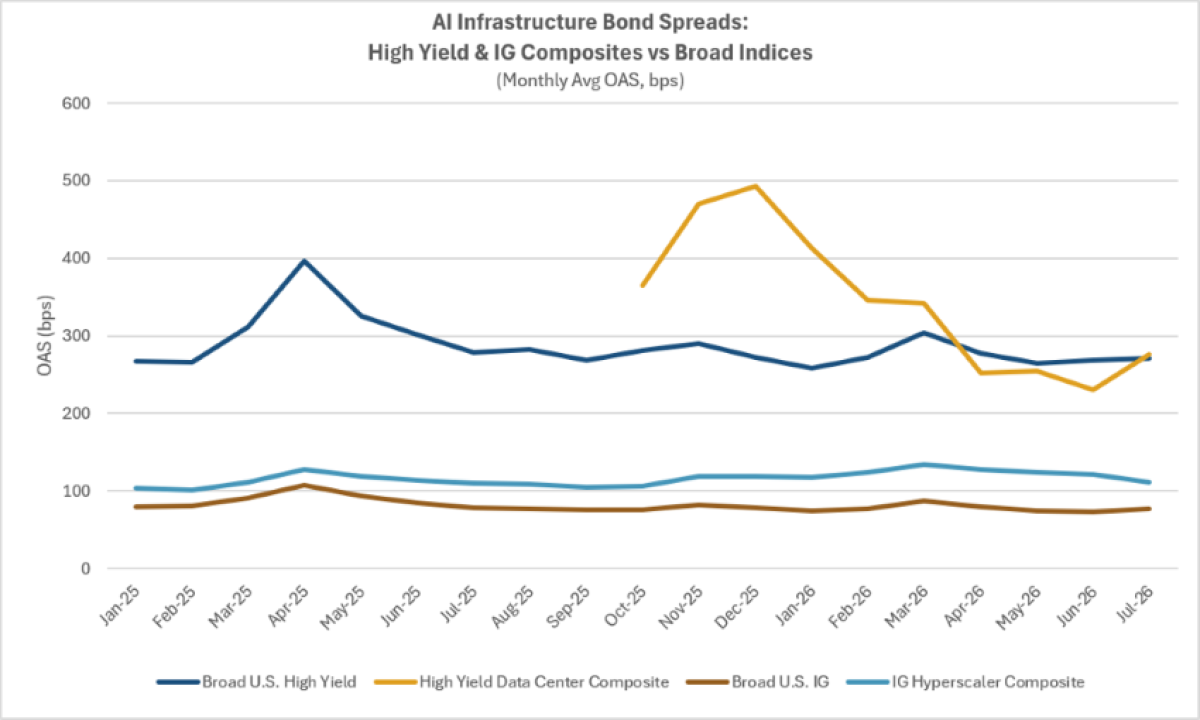
Credit markets are quietly repricing the AI infrastructure bet, and the shift is happening in both directions at once. Penn Mutual Asset Management’s analysis of AI-linked bond spreads tracks over $450 billion in AI-related debt issued since 2024 across two distinct borrower classes: investment-grade hyperscalers like Microsoft, Amazon, and Google, and high-yield data center operators like Core Scientific and TeraWulf. High-yield data center spreads compressed 220 basis points from their December 2025 peak before reversing course in late July 2026. Hyperscaler bonds, meanwhile, have widened steadily against the broad IG index all year.
What this means for your business
The companies most exposed to this story aren’t the ones issuing the bonds. They’re the ones signing the leases. If your organization has committed to long-term data center contracts anchored to hyperscaler capacity, you’re sitting inside the exact cash flow structure that bond investors are now second-guessing. The widening in high-yield data center spreads since June signals that the market no longer believes AI demand will grow fast enough to keep those lease obligations comfortable. That’s a judgment about your vendor’s financial durability, not just their pricing.
The powered shell structure matters here. Data center operators borrowed against long-term lease payments from hyperscaler tenants, essentially converting a hyperscaler’s credit rating into a bond. When spreads compressed, investors were betting that Microsoft or Amazon signing a lease was as good as Microsoft or Amazon paying a coupon. That compression has now reversed, which means the market is reassigning some construction risk, tenant concentration risk, and demand uncertainty back onto the data center operators themselves. Operators under financial pressure renegotiate leases, delay expansions, or exit markets, all of which affects your capacity commitments.
The telecom comparison from the piece deserves to be taken seriously rather than dismissed as a cautionary cliche. Telecom bonds went from 1% to over 20% of the high-yield index between 1995 and 1999, then collapsed. AI infrastructure sits at 2% to 3% of benchmarks today. The question isn’t whether this ends the same way; it’s whether your organization’s infrastructure strategy is stress-tested against a scenario where the capacity you contracted for in 2025 becomes available at a significant discount in 2028, or unavailable entirely if the operator can’t service its debt. That’s the budget assumption worth revisiting now, not after the next spread widening.
Concept deep-dive: Credit spread
A credit spread is the extra yield, measured in basis points (hundredths of a percentage point), that a bond pays above a risk-free benchmark like U.S. Treasuries. Think of it as the market’s insurance premium on a borrower’s ability to repay. When spreads widen, investors are demanding more compensation for perceived risk; when they compress, confidence is rising. For AI infrastructure bonds, spread movements are a real-time risk thermometer on whether the market believes the underlying AI demand justifies the debt being used to build for it.
Based on reporting from AI Infrastructure Bonds: A Full Picture of Spreads, originally published 2026-08-06 07:00:00.