
Share with your CTO
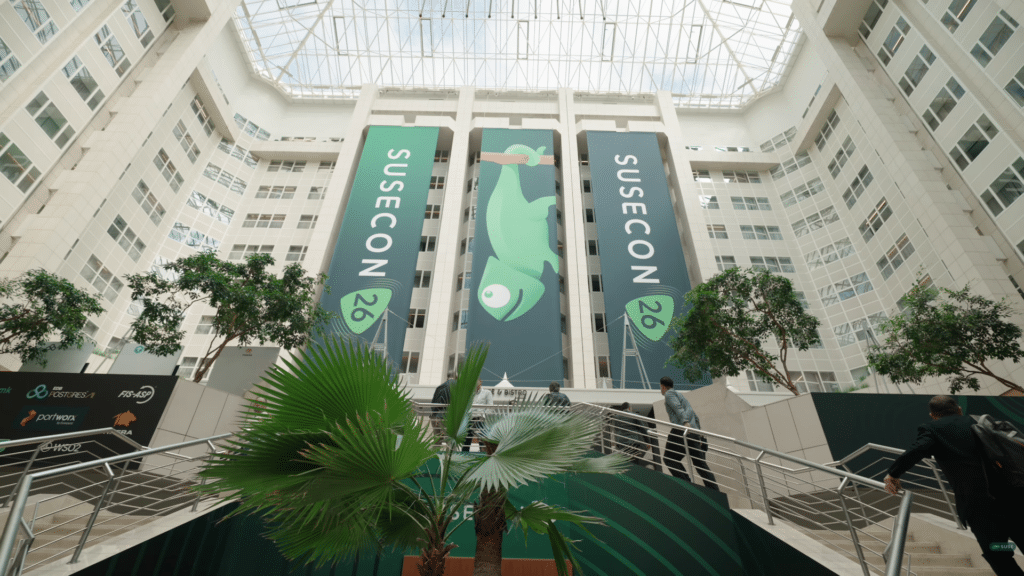
SUSE is betting that Model Context Protocol (MCP), the open standard for connecting AI agents to external systems, becomes the default interface between AI and production infrastructure before hyperscaler-proprietary alternatives do. At SUSECON 2026 in Prague, the company made that bet operational, shipping MCP integrations across Rancher Prime, Multi-Linux Manager, and SUSE AI with partners covering governance, FinOps, workflow, and autonomous remediation. Access is generally available today. Spanish retailer Grupo Eroski is the named production customer.
What this means for your business
Where you sit on this depends on how much of your Kubernetes and Linux footprint runs on infrastructure that still requires human hands to patch, restart, or correlate logs. SUSE’s MCP layer lets agents do that work directly against production systems, governed by protocol rather than by a vendor’s closed API. If your operations team is already evaluating agentic automation for infrastructure, this announcement moves the buy-or-wait clock. If you’re running Red Hat or Canonical stacks, neither company has positioned MCP as an ops protocol yet, which means you’re watching, not choosing.
The partnering pattern SUSE chose is worth examining on its own terms. Instead of building agent governance and cost controls internally, SUSE wired in Stacklok for MCP server vetting and Revenium for financial guardrails on agent actions. The assembly is faster and likely stronger in each component than in-house builds would be. The risk is dependency concentration: if any partner pivots or gets acquired, the integrated capability breaks. That’s a real architectural consideration, not a dealbreaker, but it belongs in your vendor dependency map before you commit to the stack.
The Revenium integration introduces a cost category that most FinOps tooling currently ignores. Token metering captures what an agent costs to run. It doesn’t capture what the agent’s downstream actions cost, infrastructure provisioned, services restarted, configurations changed. Call it agent-driven cost drift. If Datadog or Dynatrace adds agent-action accounting within the next two quarters, the category becomes a standard line item in your infrastructure budget. If they don’t, Revenium sits as a niche add-on. That trajectory is the indicator worth tracking, not SUSE’s partner list itself.
Concept deep-dive: Model Context Protocol (MCP)
MCP is an open standard, think of it as a universal adapter, that lets AI agents connect to external tools, data sources, and systems without custom point-to-point integrations. It exists because every vendor building agents was otherwise creating proprietary connectors that couldn’t talk to each other. The business connection is straightforward: a protocol that becomes the standard for agent-to-infrastructure communication gives whoever controls the trusted registry of compliant servers a quiet veto over which agents enterprises actually deploy.
Based on reporting from SUSECON 2026 – Big Bet On MCP and Partners for Infrastructure AI Operations, originally published 2026-04-24 03:00:00.