
Share with your CTO
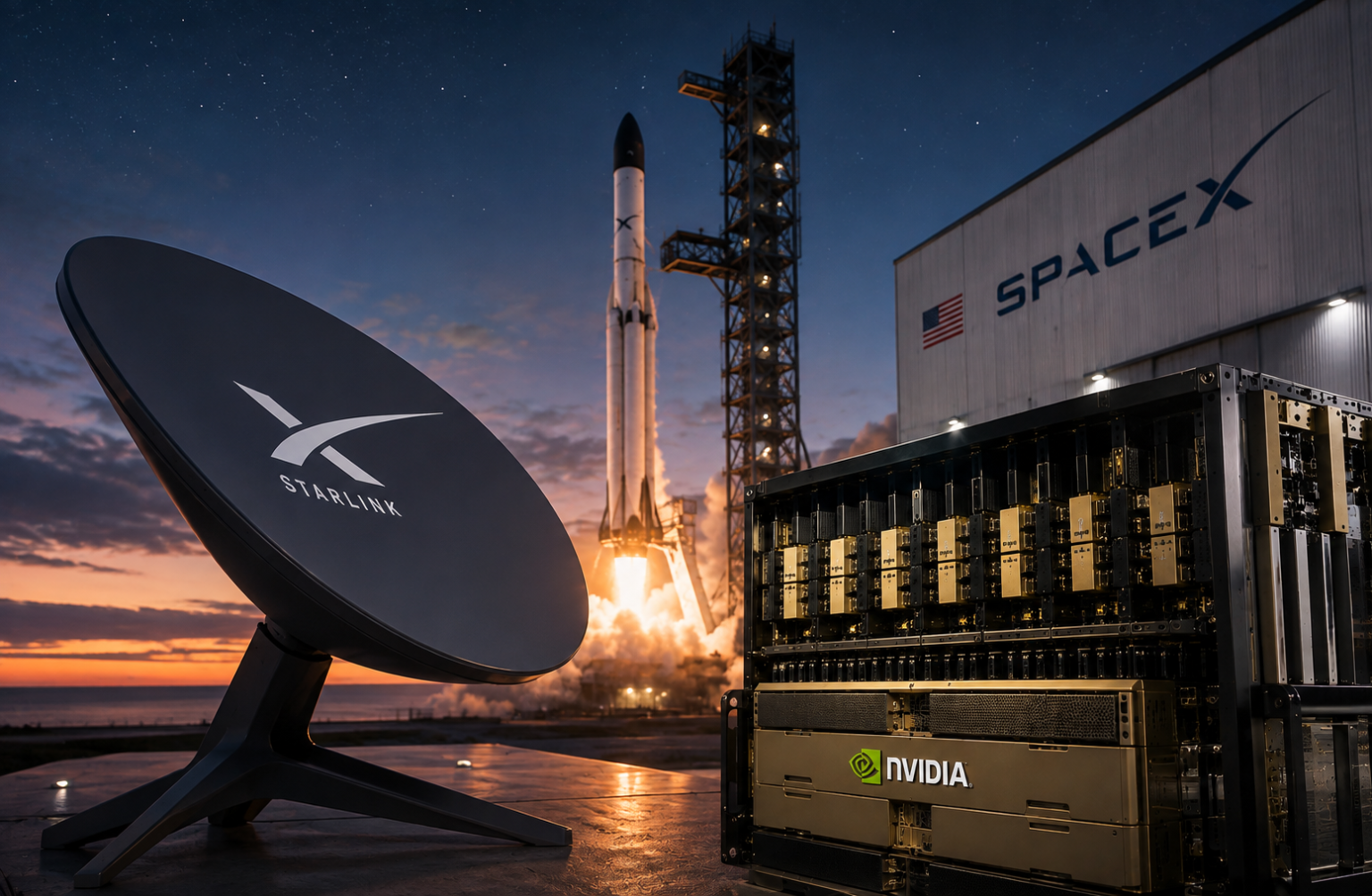
SpaceX has committed exclusively to Nvidia’s upcoming Vera Rubin NVL72 architecture for all future AI infrastructure, on Earth and in orbit. Elon Musk made the declaration on SpaceX’s earnings call, citing Vera Rubin as the best available AI computing platform, a rack-scale system that consolidates compute, networking, and power into a single deployable unit. The company also plans to launch its first Starmind AI satellite next year, running the same Nvidia architecture in space. Nvidia shares rose on the news. Read the full SpaceX-Nvidia exclusivity announcement for details.
What this means for your business
Exclusive vendor commitments from operators at SpaceX’s scale don’t just reflect a technical preference, they reshape the negotiating table for everyone else. If you’re currently running a multi-vendor AI compute strategy that includes AMD or Intel accelerators as a hedge, this announcement doesn’t invalidate that position, but it does tighten Nvidia’s grip on reference architecture credibility. The companies most exposed are those whose own AI roadmaps depend on a competitive Nvidia alternative materializing at price or performance parity within the next 18 months.
The Vera Rubin NVL72’s rack-scale design is worth understanding on its own terms. Conventional AI server racks require extensive custom cabling between compute nodes, networking switches, and power distribution, which creates failure points and slows deployment. A rack-scale system ships as a pre-integrated unit, collapsing that complexity. SpaceX’s interest in deploying it in orbit is less a stunt than a real engineering test: if the architecture is reliable enough for a satellite environment where maintenance is essentially impossible, that’s a meaningful signal about its terrestrial operational characteristics.
The pattern here is vendor lock-in dressed as architectural conviction, and Nvidia has earned that framing honestly. xAI trained Grok on Hopper and Blackwell, SpaceX now commits to Vera Rubin, and the Musk ecosystem becomes a living proof-of-concept Nvidia can cite in every enterprise sales conversation. For CTOs evaluating their next infrastructure cycle, the relevant question isn’t whether Nvidia is technically superior today. It’s whether your organization can absorb the cost and dependency concentration that comes with matching this kind of commitment, and whether a credible alternative will exist before your current contracts expire.
Concept deep-dive: Rack-scale AI architecture
A rack-scale system treats an entire server rack as a single engineered unit rather than a collection of individually assembled components. Nvidia’s NVL72 ships GPUs, high-speed interconnects, and power delivery pre-integrated, the way a smartphone ships its processor and memory soldered together rather than slotted into separate sockets. The business consequence is faster deployment and fewer integration failure points, but it also means the vendor controls the full hardware stack, which concentrates both performance gains and switching costs in the same decision.
Based on reporting from SpaceX backs Nvidia exclusively for future AI infrastructure, originally published 2026-08-05 15:28:00.