

Share with your CTO
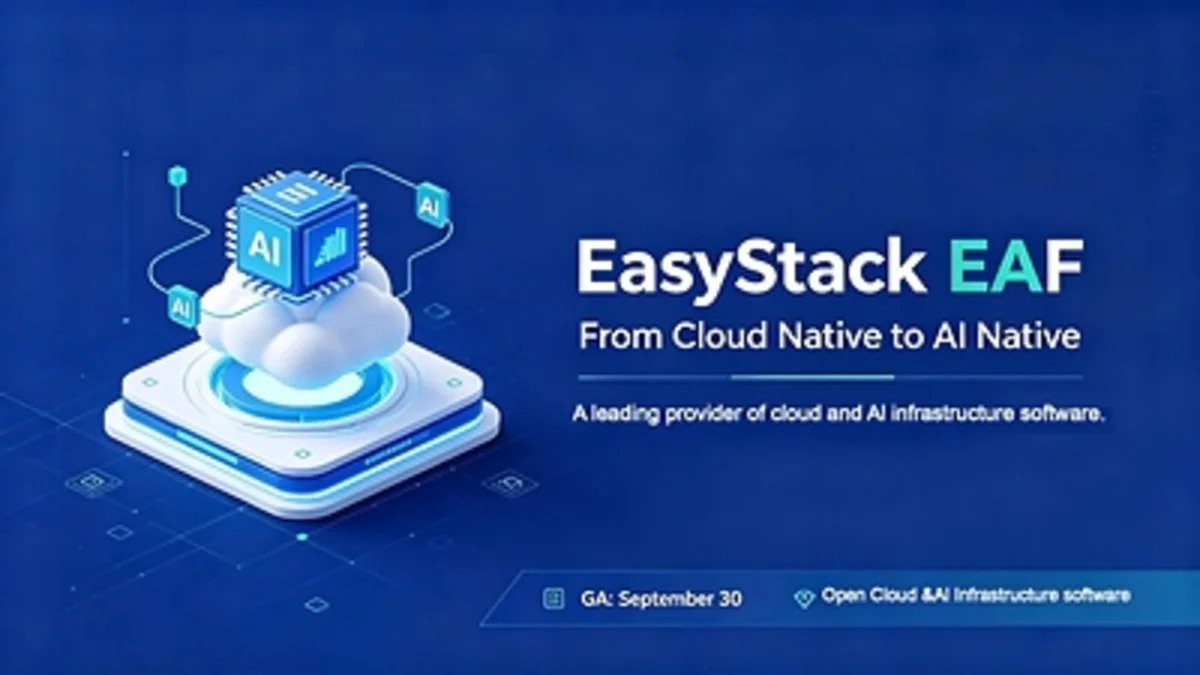
EasyStack is betting that enterprises don’t want to rebuild their infrastructure stack to run AI workloads, and it’s productizing that bet with EAF, its AI infrastructure platform launching September 30, 2026. The platform manages heterogeneous GPU architectures, including NVIDIA, Huawei Ascend, and Hygon DCU, from a single control plane, with per-AI-card licensing and no hardware or model lock-in. It slots into EasyStack’s existing portfolio alongside its cloud foundation and cloud-native platform, serving more than 2,000 enterprise customers across Asia, the Middle East, Europe, and the Americas.
What this means for your business
The question EAF actually answers isn’t whether you can run AI on your existing cloud, it’s whether your infrastructure team has to become two separate teams to do it. If your organization already runs on an OpenStack-derived or private cloud foundation and has been quietly accumulating GPU cards for inference workloads, the relevant pressure point is operational complexity, not raw compute. EAF’s pitch lands hardest for CTOs who are already managing heterogeneous hardware and don’t want a second orchestration layer from a second vendor.
The heterogeneous GPU management angle is the substantive claim worth scrutinizing. Most enterprises buying inference capacity right now are NVIDIA-heavy, but Chinese regulatory pressure and supply constraints have pushed a real cohort of EasyStack’s customer base toward Huawei Ascend and Hygon DCU. EasyStack, operating primarily from China with a global commercial layer on top, has structural reasons to make multi-chipset abstraction work that a US-headquartered infrastructure vendor simply doesn’t face, which means this feature isn’t marketing padding. It reflects an actual constraint in the customer base.
The per-AI-card licensing model is worth a second look before any procurement conversation. It aligns costs with actual hardware deployed rather than CPU cores or cluster size, which looks attractive during PoC phases but can compound quickly once production inference workloads scale. If your GPU fleet grows faster than your inference token demand, you’re paying for idle capacity. I’d revisit this view if EasyStack introduces consumption-based pricing at scale, but absent that, the licensing model favors buyers who have disciplined hardware procurement, not those still sizing their AI infrastructure by trial.
Concept deep-dive: Heterogeneous GPU orchestration
Heterogeneous GPU orchestration means managing compute accelerators from different chip vendors, NVIDIA, AMD, or domestic Chinese alternatives like Ascend, through a single software control plane rather than separate toolchains for each. Think of it as a universal remote for GPUs that speak different dialects. For enterprises, the business case is avoiding siloed infrastructure teams and duplicated operational tooling every time a new chip vendor enters the stack, which matters most when procurement decisions are constrained by geopolitics or supply availability rather than pure performance preference.
Based on reporting from EasyStack Launches EAF, an AI-Native Cloud Foundation for Enterprises, originally published 2026-09-16 05:30:00.