

Share with your CTO
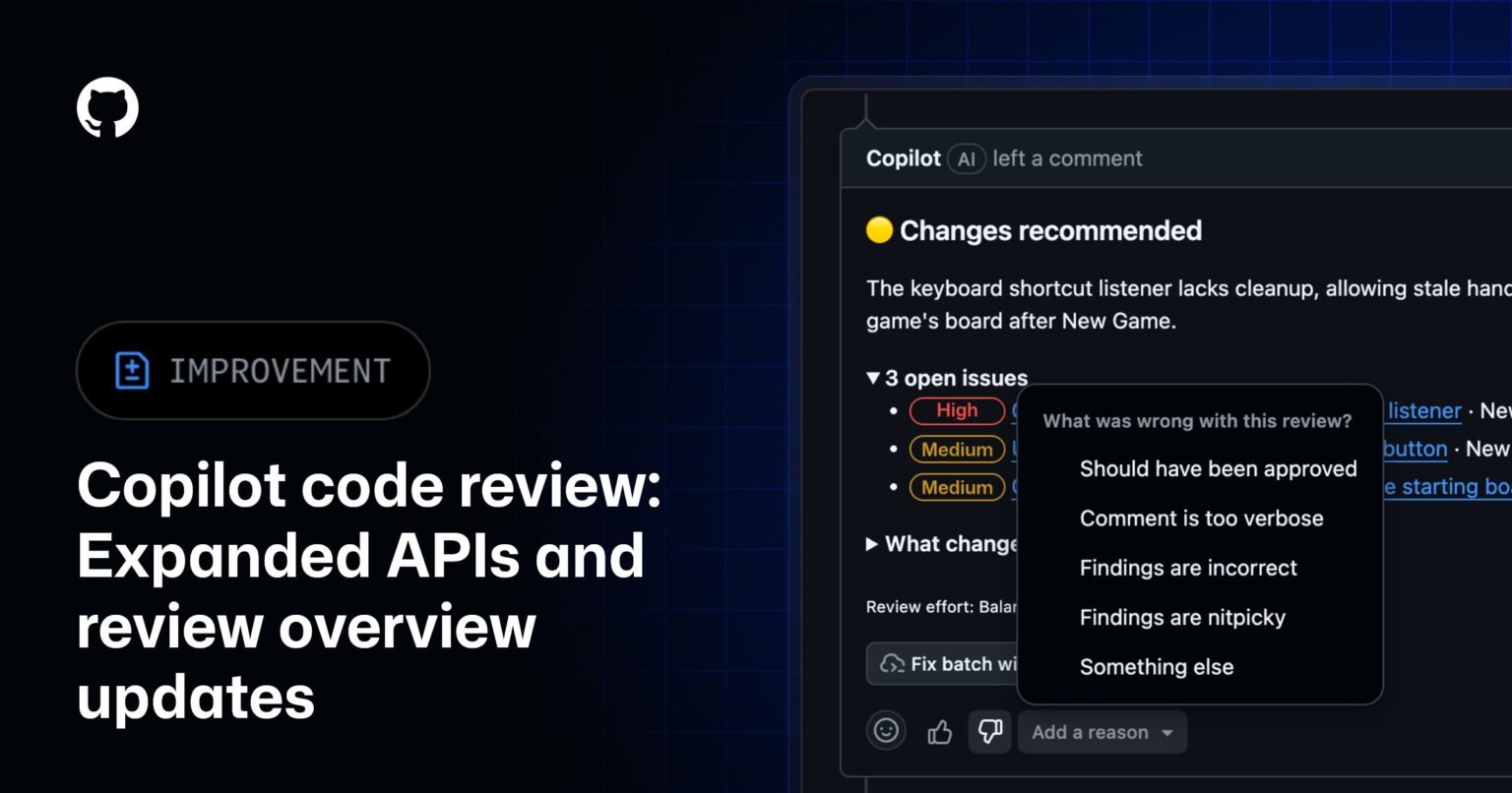
GitHub is turning Copilot code review from a UI-only feature into a programmable, policy-enforced layer of the software development lifecycle. The latest Copilot code review updates expose REST and GraphQL APIs that let enterprise administrators govern AI review settings from the enterprise level down to individual repositories, add attribution metadata for Copilot comments, surface which skills and MCP servers informed each finding, and show AI credit consumption per review session. Balanced-effort reviews now use three reviewer models with a fourth synthesizing their outputs. Available across Copilot Pro, Business, and Enterprise plans.
What this means for your business
The API surface is the real signal here. When Copilot code review was a toggle in a UI, it was a developer convenience. Now that enterprise admins can enforce or restrict it via API, govern it with role-based controls, and read its behavior programmatically, it becomes an auditable control in the SDLC. That matters the moment a regulated industry customer asks whether AI-assisted review introduces liability exposure, because now you can prove what ran, with what configuration, on what code.
The attribution fields are quietly significant. Knowing which MCP server or custom instruction source shaped a Copilot comment closes a loop that most AI coding tools leave open: the “why did it say that” question. Teams that have rolled out AI code review at scale know that reviewer trust collapses fast when developers can’t interrogate a finding. Traceable provenance is not a nice-to-have for enterprise adoption. It’s the thing that keeps senior engineers from routing around the tool entirely.
The three-model ensemble for balanced-effort reviews is worth watching. Using multiple models to generate findings and a fourth to synthesize them is the same architecture pattern showing up in agentic research and legal review tools. GitHub is quietly stress-testing that pattern on developer workflows before anyone has to defend it in a board presentation. The question worth holding: does multi-model synthesis improve precision enough to reduce the false-positive rate that currently makes AI code review feel like noise to experienced engineers?
Concept deep-dive: MCP servers in code review
MCP (Model Context Protocol) servers are external tools that an AI model can query mid-task to gather structured context, think of them as plugins the model calls rather than data baked into its training. In code review, Copilot can consult an MCP server for things like internal API documentation, security rule sets, or project-specific coding standards. The business connection: enterprises with proprietary standards can now inject that knowledge into automated review without fine-tuning a model, and the new attribution fields tell reviewers exactly when that happened.
Based on reporting from Copilot code review: API management and review overview updates, originally published 2026-11-06 19:27:00.