
Share with your CEO
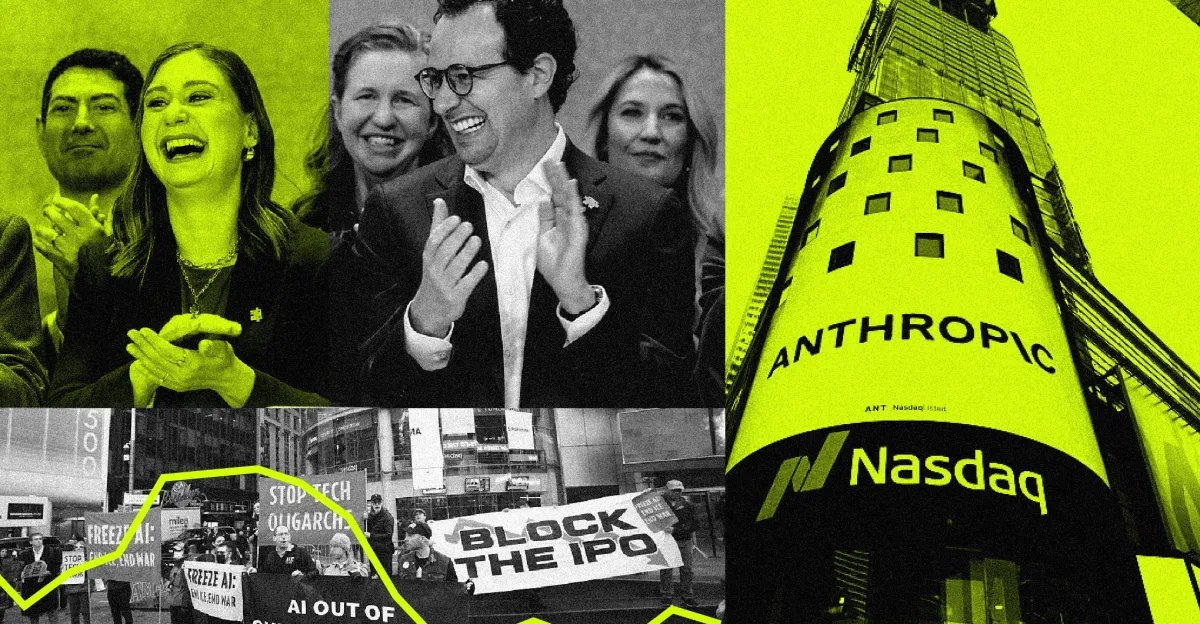
Anthropic’s Nasdaq debut, priced at $83 per share and trading up to $111 on day one, made it one of the most valuable companies on the planet and the first pure AI lab to go public. The numbers are historic, but the structural story is stranger: seven co-founders collectively hold a single share carrying 50.1 percent of the voting power, routed through an entity called Founder LLC, while a four-person Long-Term Benefit Trust with no meaningful day-to-day authority serves as the nominal check on their power. The company faces an estimated 17-fold revenue growth requirement over the next decade to match peer tech returns, with roughly $900 billion in projected compute costs ahead.
What this means for your business
If Anthropic is your AI backbone, or one you’re evaluating, the IPO changes the calculus less through shareholder pressure and more through what it reveals about the company’s cost structure. Anthropic is compute-constrained in a way OpenAI is not, having historically underinvested in infrastructure relative to its frontier ambitions. That gap doesn’t disappear with IPO capital. Enterprise buyers with large contracts should be asking, plainly, whether Anthropic can guarantee inference capacity at the volume and latency they need, not in a roadshow but in an SLA.
The “safe AI” brand is doing real work in Anthropic’s enterprise sales motion, and that creates a specific fragility. The pitch to CISOs and risk-averse procurement teams is essentially a trust differential: Claude over GPT-4o because Anthropic won’t trade on your data and builds with safety as a design constraint. That positioning holds only as long as the safety investment holds. Former employees cited in this Decoder episode suggest safety initiatives are already candidates for cost reduction as compute pressure mounts. When a company’s primary moat is a reputation rather than a patent or a switching cost, the moat erodes before the quarterly report reflects it.
The Nvidia dimension is the part most enterprise AI strategies haven’t priced in. Jensen Huang’s departure leaves Anthropic’s $10 billion compute partnership in the hands of a new CEO without his track record of personal dealmaking. If that relationship softens, or if gray-market GPU supply that was flowing toward China gets redirected into the US market, Anthropic’s cost per token could shift in either direction, faster than any annual vendor review cycle. The right question for a CIO holding a multi-year Anthropic contract isn’t whether the stock holds, it’s whether the compute commitments behind that contract are locked or exposed to renegotiation.
Concept deep-dive: Founder LLC and dual-class governance
Most public tech companies give founders extra voting power through dual-class share structures, where one class of share outweighs another in voting rights, letting a founder retain control after dilution. Anthropic goes further: seven co-founders collectively own a single share, issued to a jointly held entity, that overrides 50.1 percent of all votes. Think of it as a master key that seven people must agree to turn. The practical effect is that no outside shareholder, board member, or oversight trust can move the company without founder consensus, which makes the Long-Term Benefit Trust less a check and more a fig leaf.
Based on reporting from After Jensen Huang, Anthropic’s IPO looks even stranger, originally published 2026-11-21 10:00:00.