
Share with your CIO
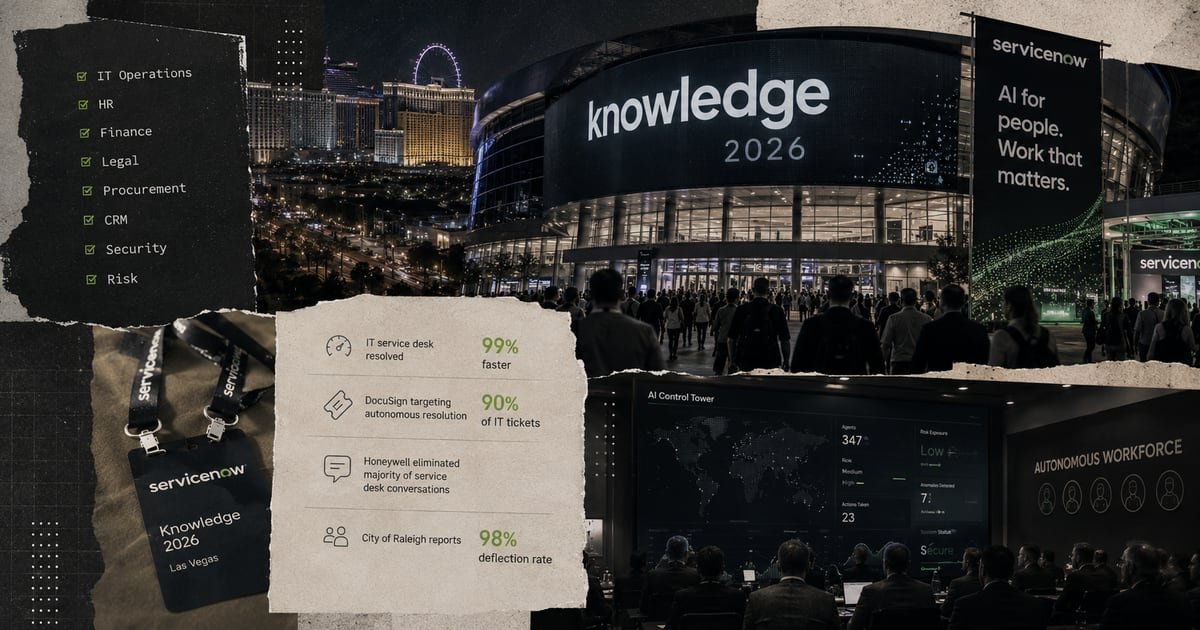
ServiceNow is betting its next decade on autonomous AI specialists becoming standard enterprise infrastructure, the way ERP did a generation ago. At Knowledge 2026, the $95 billion platform extended its Autonomous Workforce across IT, HR, finance, legal, procurement, CRM, and security. Early numbers are striking: DocuSign is targeting 90% autonomous IT ticket resolution, and the city of Raleigh reports a 98% employee-request deflection rate. The governance layer, an AI Control Tower that discovers, risk-scores, and can kill any agent running across AWS, Azure, or Microsoft 365, may matter more than the agents themselves.
What this means for your business
The 84% of organizations that claim active AI deployment but haven’t embedded it across functions aren’t losing to a better model. They’re losing to their own operational foundations. Deloitte’s 2026 figure, that only 16% have successfully embedded AI workflows enterprise-wide, maps almost exactly onto a predictable failure pattern: fragmented workflows, siloed data, and no governance layer. If your organization fits that description, the ServiceNow benchmarks aren’t a target yet. They’re a diagnostic of what’s missing.
ServiceNow’s Control Tower framing is worth taking seriously on its own terms, even for shops not running ServiceNow. The platform governs agents across competing clouds and Microsoft 365, which means it’s positioning itself as the control plane for the entire agentic layer of the enterprise, not just its own products. The “zero-permissions” architecture it’s advancing, where agents receive only the access a specific task requires and no more, is emerging as the operational equivalent of zero-trust network security. Organizations deploying autonomous agents today without this kind of governance are accumulating audit and compliance exposure that won’t show up until the next regulatory review or contract renewal. The risk is real and it’s deferred, which makes it easy to underweight.
The escalation path is the part of this story that belongs on your org chart, not your vendor evaluation. ServiceNow’s 99% faster resolution metric is a platform capability. Who receives the case when the agent hits its judgment limit, how fast they respond, and whether that handoff is designed or improvised, that’s an organizational design decision your CIO owns. If that design isn’t documented before deployment, the benchmark numbers become a ceiling instead of a floor. I’d revise this view if the early-adopter results held up in organizations with genuinely fragmented data environments, but so far the pattern is consistent: readiness precedes performance, not the other way around.
Concept deep-dive: Workflow Data Fabric
A workflow data fabric is a unified data layer that connects records, permissions, and process logic across otherwise disconnected enterprise systems, think of it as a live index of “what happened, where, and who owns it” across every tool the business runs. ServiceNow’s version draws on more than 100 billion workflows processed annually to give its AI specialists operational context no point solution can replicate. Without it, an AI agent resolving an IT ticket can’t verify whether the requestor’s access has already been provisioned elsewhere, or whether a related asset is already flagged for retirement.
Based on reporting from ServiceNow Autonomous Workforce: What to evaluate first, originally published 2026-07-02 03:00:00.