
Share with your COO
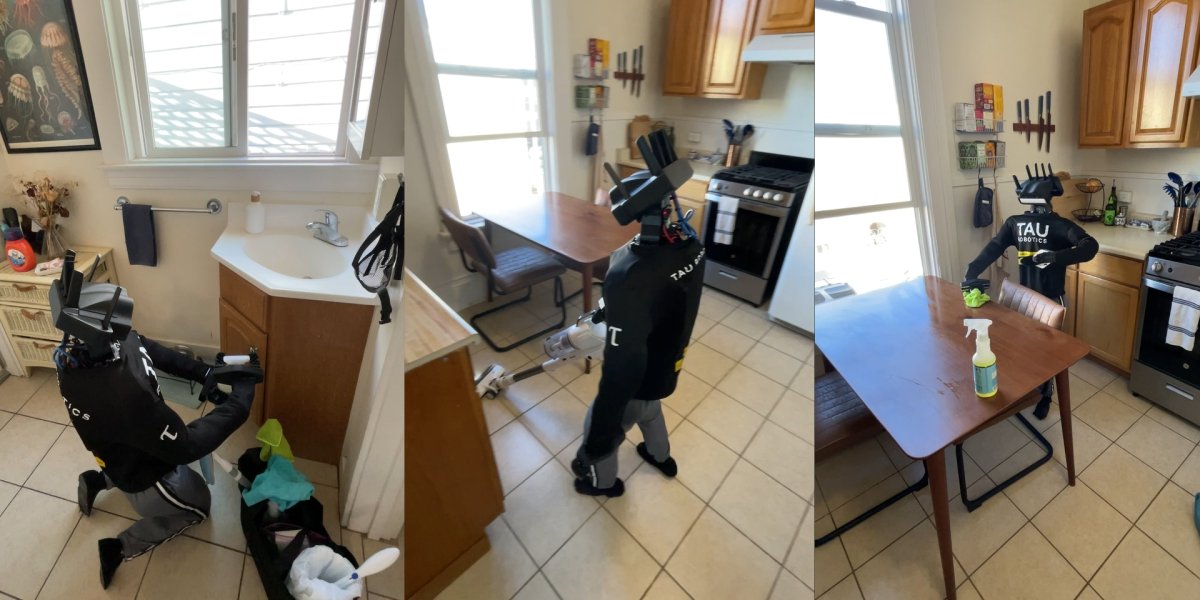
Tau Robotics is betting that humanoid robots can enter the home services market now, before the hardware is ready, by keeping humans in the loop via remote teleoperation (a human operator watching and guiding the robot from headquarters over a live connection). The MIT Technology Review first-person account shows a robot that struggles with stairs, overheats, and stops cold when the remote operator’s equipment fails, yet Tau is already charging customers and collecting data at scale.
What this means for your business
The story that matters here isn’t about one wobbly robot cleaning one apartment. It’s about the go-to-market pattern Tau is running, which looks a lot like early autonomous vehicle deployments: ship an undercooked product, paper over the gaps with remote human labor, and collect proprietary training data while customers pay for the privilege. Any COO evaluating robotic automation for facilities, logistics, or field services should recognize this pattern immediately, because it determines whether a vendor’s demo is a preview of real capability or a staffed performance.
The dependency Tau has built into its current model is worth naming precisely. When the remote operator’s equipment overheated, the robot stopped. That’s not a hardware failure at the deployment site; it’s a supply chain of human attention sitting offsite, invisible to the customer, and entirely uncovenanted in the service agreement. Enterprises that have absorbed this lesson from early RPA deployments (robotic process automation, software bots that automate repetitive digital tasks) know that “automated” services with hidden human backstops carry a fundamentally different cost structure and reliability profile than the pitch implies. Tau’s robot isn’t autonomous; it’s a telepresence interface with legs.
The honest signal in this piece is that Tau’s data collection strategy may be sounder than its current product. Every cleaned apartment, every stumble on a staircase, every remote-operator correction feeds the training corpus that could eventually make the robot genuinely autonomous. The COO who signs an early contract is subsidizing that R&D while accepting operational risk. That’s not necessarily wrong, but it should be priced explicitly. If a vendor can’t tell you the ratio of autonomous to human-assisted task completions in your deployment, you’re not buying automation; you’re buying a research partnership on someone else’s terms.
Concept deep-dive: Teleoperation
Teleoperation means a human operator controls a robot remotely in real time, watching through the robot’s cameras and sending movement commands over a network connection. Think of it as a video game where the character is a physical machine in someone’s home. It exists because robot autonomy for unstructured environments (kitchens, staircases, cluttered rooms) remains unsolved. The business catch is latency: even a small signal delay, as Tau’s own engineers acknowledge, visibly degrades coordination and creates the failure modes a customer actually sees.
Based on reporting from I watched a humanoid robot clean my apartment. It felt like a taste of the future., originally published 2026-11-06 05:00:00.