

Share with your CTO
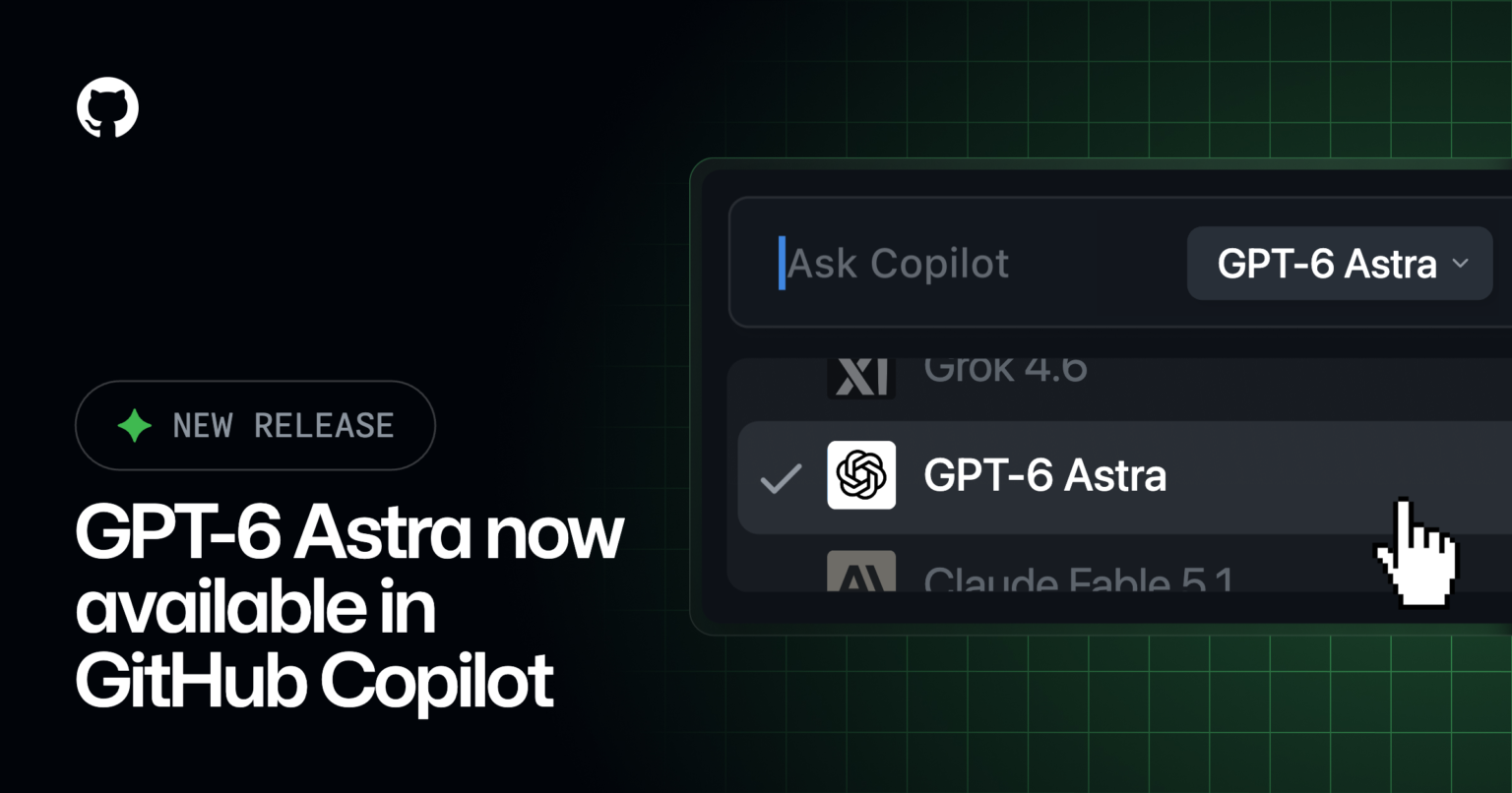
GitHub is betting that autonomous, long-horizon coding is the next frontier for developer productivity, and it’s deploying OpenAI’s GPT-6 Astra as its answer. The GPT-6 Astra rollout in GitHub Copilot makes the model available to Pro+, Max, Business, and Enterprise subscribers across every major IDE and the GitHub coding agent. Unlike prior Copilot models, Astra is designed to plan, validate, and verify its own outputs mid-task, completing long coding workflows in fewer steps than its predecessors. Billing runs at OpenAI’s provider list pricing under usage-based billing.
What this means for your business
The jump from autocomplete to autonomous is not incremental. A model that confirms its own results before declaring a task complete changes what you can actually delegate to it. Think multi-file refactors, cross-service debugging sessions, or full feature scaffolding run end-to-end without a developer in the loop at every step. That is a different category of tool than what most engineering teams have been using, and it demands a different category of governance around it.
The recurring failure mode with agentic coding tools is underestimating how fast they accumulate technical debt when no one audits their outputs. Astra’s self-verification loop is designed to reduce that risk, but “independently confirms its results” still means the model is grading its own homework. The real exposure is at the boundary where Astra’s confidence ends and human review should begin. Engineering orgs that don’t define that boundary explicitly will discover it the hard way, usually in a production incident.
Default model enablement is the policy detail your team is most likely to miss. Under GitHub’s current settings, new models like Astra are automatically enabled for Business and Enterprise plans unless an admin has disabled the global default. That means Astra may already be live in your developer workflows right now, billed at usage rates your procurement team did not explicitly approve. The signal worth watching: how quickly your Copilot spend moves in the next two billing cycles.
Concept deep-dive: Long-horizon agentic tasks
A long-horizon task is one that requires multiple sequential decisions, each dependent on the outcome of the last, without human input between steps. Standard code completion tools handle a single prompt and stop. An agentic model like Astra takes a goal, breaks it into subtasks, executes them in order, checks intermediate results, and adjusts course before finishing. Think of it as the difference between asking a contractor to cut one board versus handing them blueprints and coming back at the end of the day. The business implication is real leverage on complex engineering work, paired with real exposure if the model’s judgment diverges from your team’s intent.
Based on reporting from GPT-6 Astra is generally available in GitHub Copilot, originally published 2026-09-04 14:59:00.