

Share with your CTO
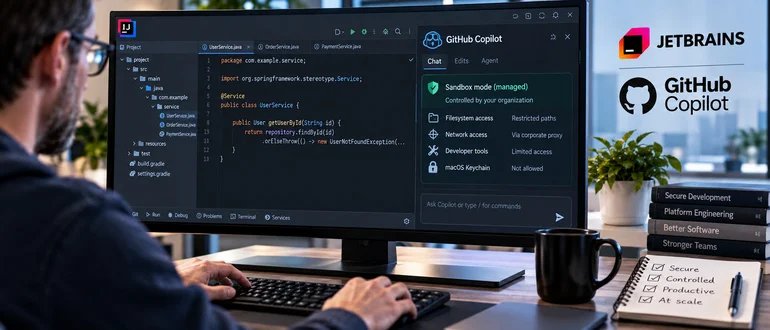
GitHub is pushing enterprise sandbox governance for Copilot in JetBrains IDEs into public preview, giving platform teams direct control over what an AI coding agent can touch: filesystem paths, network routes, proxy settings, developer tools, and macOS Keychain access. The controls live inside the Copilot plugin itself, not in Intune or another MDM layer, and settings locked by an admin appear marked “(managed)” so developers can’t locally override them. A new policy diagnostics tool lets teams confirm enforcement is actually landing on developer machines before enabling Copilot’s more autonomous modes.
What this means for your business
JetBrains is where your Java and Kotlin backend teams live, often inside monorepos wired to production systems. When Copilot moves from autocomplete to executing shell commands and editing across files autonomously, the IDE stops being a passive editor. It becomes an agent runtime with read-write access to code, credentials, and network paths. That’s a materially different risk surface than what your device management policies were written to cover.
The governance gap GitHub is closing here has a specific shape: MDM policy is broad and slow. A security team needing to restrict an AI agent’s filesystem access through Intune faces a change-request cycle measured in days. A policy baked into the Copilot plugin itself can be updated and propagated in an afternoon. That speed difference matters most when agentic features are shipping faster than your security team can review them, which is the situation most enterprises are in right now.
The signal worth watching is that GitHub has now added managed controls for plugins, MCP server allowlists, telemetry routing, and sandbox policy across three consecutive months. That’s not a roadmap, it’s a catch-up pattern. Every new agentic feature GitHub ships creates a governance surface that didn’t exist before, and the controls are arriving after the features, not before. The question for your platform team isn’t whether these guardrails are enough today. It’s how many autonomous Copilot modes are already running on developer machines without any of these controls confirmed active.
Concept deep-dive: Agent sandboxing
An AI coding agent sandbox is a permission boundary that restricts what the agent’s process can read, write, or contact during execution. It exists because agentic AI doesn’t just suggest code: it runs commands, edits files, and can initiate network calls. Without explicit constraints, those actions inherit the developer’s full local permissions. Think of it like a contractor with a master key who should only need access to one floor. Sandboxing issues the right-sized keycard. For enterprises, the business case is simple: an agent that can’t reach your secrets store can’t exfiltrate it.
Based on reporting from GitHub Puts Guardrails on Copilot’s Sandbox Inside JetBrains IDEs, originally published 2026-09-09 11:47:00.