

Share with your CTO
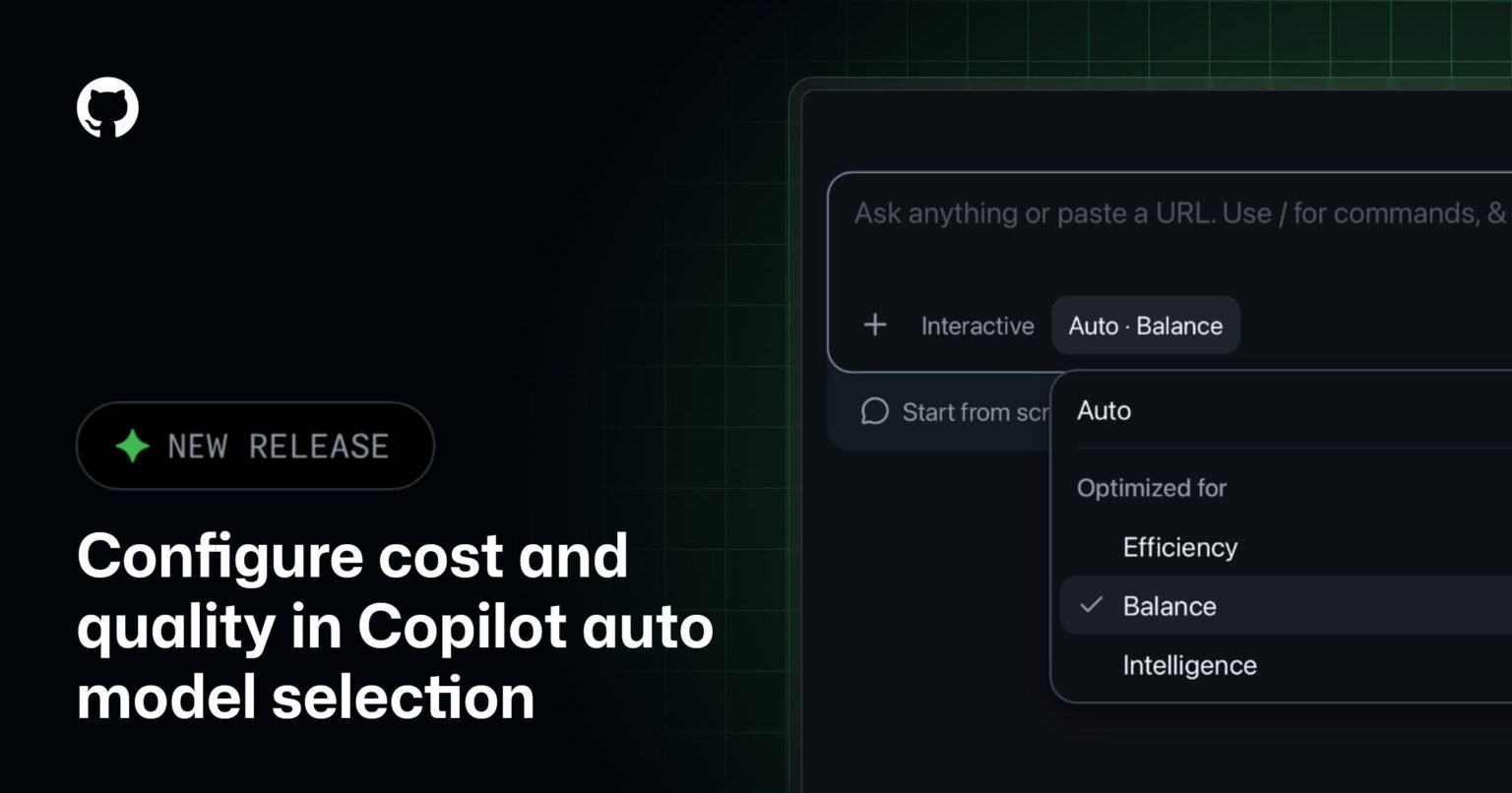
GitHub is giving engineering organizations direct control over the cost-quality tradeoff in Copilot’s automatic model selection, introducing three configurable tiers: Efficiency, Balance, and Intelligence. The feature, now rolling out across VS Code, Copilot CLI, and the GitHub Copilot app, lets teams set how aggressively Copilot should optimize for speed and cost versus output quality on a per-prompt basis. Billing follows the model actually selected, not the tier chosen, and paid subscribers keep their 10% discount on usage billed through Copilot auto model selection.
What this means for your business
This is about moving AI tooling cost from fixed to variable in a way engineering leaders can actually manage. A team running thousands of docstring completions and inline suggestions daily burns through token budget on tasks that don’t need frontier-model capability. Pointing those workloads at the Efficiency tier while reserving Intelligence for architecture generation or complex refactors isn’t just cost hygiene. It’s the first time Copilot gives you a dial instead of a default.
The recurring failure mode in enterprise AI adoption is that organizations negotiate a seat-based contract, treat all usage as equivalent, and then discover their cost-per-developer is driven almost entirely by a narrow slice of heavy, complex queries. GitHub is essentially offering a crude but real FinOps layer for developer AI, one where the classification happens at the prompt level rather than requiring engineers to manually select models. That automatic routing, even imperfect, is more likely to produce consistent behavior at scale than relying on individual developers to pick the right model for each task.
The tradeoff is real: “auto” selection is still a black box. GitHub acknowledges this is step one toward “more visibility into the tradeoffs you’re making,” which means current telemetry on which models are being selected, and why, is thin. Before committing to an Intelligence-tier default across a large engineering org, it’s worth asking what reporting GitHub surfaces on actual model distribution per tier. The signal worth watching is whether GitHub ships usage dashboards that let engineering leaders see cost-by-tier breakdowns before the invoice arrives.
Concept deep-dive: Prompt-level model routing
Prompt-level model routing means an orchestration layer evaluates each individual request and dispatches it to the model best suited for that specific task, rather than sending all requests to a single model. It exists because large language models vary dramatically in cost and capability, and most tasks don’t require the most powerful option. Think of it like airline seat classes on the same flight: the destination is the same, the experience differs by what you pay. For enterprises, the business connection is straightforward: routing low-complexity prompts to smaller models can cut per-seat AI costs without degrading output quality on work that matters.
Based on reporting from Configure cost and quality in Copilot auto model selection, originally published 2026-09-14 12:05:00.